
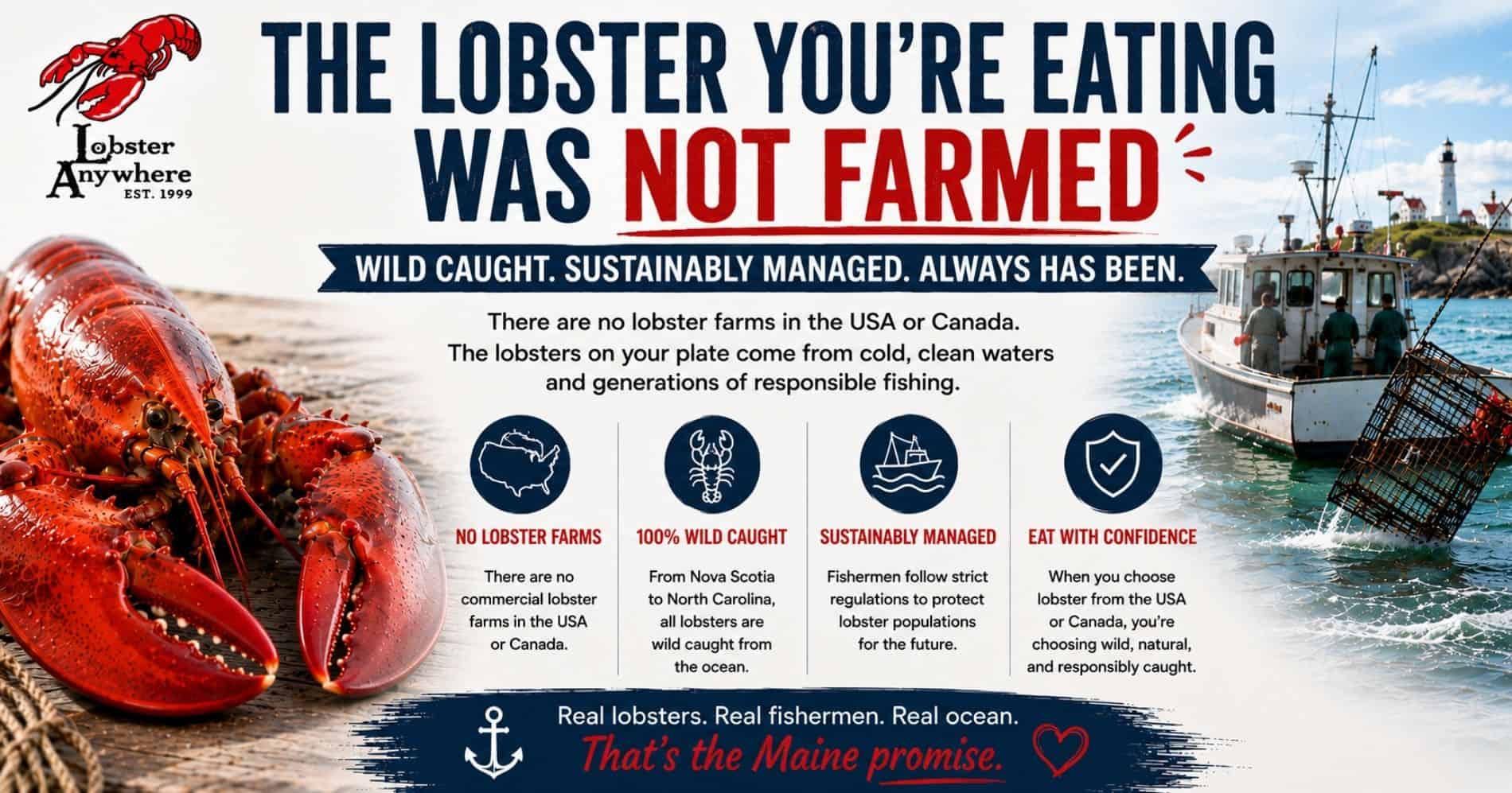
Has someone told you that you shouldn’t eat lobster because it was farmed, and that farmed lobsters are unhealthy? Was this in the USA or Canada? Good news, the lobster you are eating was very likely not farmed, and if it was a Maine Lobster (the one with two large claws), it is almost guaranteed to be wild caught.
There are no lobster farms in the USA or Canada as it is not practical financially to farm lobsters as their growth cycles are too slow, and it is not humane as the lobsters are bottom dwellers and not swimmers like fish. This would require massive facilities so they don’t wind up in a pile, and lobsters in a farm would likely begin eating each other. Farmed lobsters would spend an excessive amount of time (roughly five to seven years) before they grew to a size where they could be ready for the commercial food supply. It is much more economical to fish them from the wild, and it is better for them environmentally.
One way the rumor about lobster farming started is because of a “lobster pound”. These are the holding tanks the lobsters sit in at grocery stores, restaurants, and markets. These pounds display live lobsters stacked on top of each other, and sometimes the water may not look that fresh. These are holding tanks and do not signify that there is a farm or that the lobsters came from one.
Fun fact: There was a shrimp farm in the desert in Nevada that no longer exists, and this shrimp farm is one of the reasons the lobster farm myth exists. If you can farm shrimp in the desert, you can farm lobsters on land. Mostly wrong!
There are some lobster farms around the world, but their main purpose is repopulation, and they almost exclusively raise the spiny lobster like the type you’ll find in the Caribbean and California.
Where Lobster Farms Exist
There are lobster farms in Norway and across Southeast Asia. While the ones in Vietnam are infamous for producing massive specimens, most are there to help with repopulation.
The Norwegian lobster farm is an experiment to help increase the population of the European lobsters and to raise lobsters for food. They have successfully been able to raise lobsters for food, but it is unlikely this can increase with current technology to create a global supply, and it is specific to the European lobster.
Vietnam is likely the most recognizable and well known example of a sizable lobster farm where they regularly produce large lobsters for the commercial food supply. While the size is impressive for lobsters, it is small in proportion to farms that produce seafood for commercial usage. Just like the lobsters farms in Indonesia and the Philippines, these farms rely on catching larvae and raising it vs breeding and hatching the eggs (roe) at the farm.
Australia has also jumped into the market and is trying to find a way to commercially produce lobsters for consumers. The interesting thing about this venture is they are trying to hatch from eggs vs. collecting larvae and growing them.
Unfortunately the sustainability of lobster farming, even the pearl lobster in the Indonesian farms has yet to achieve a strong enough result to be considered sustainable.
Fun fact: If someone tells you a farmed lobster has a softer shell than a wild caught, you can prove them wrong. Soft shells mean the lobster was molting and was caught during peak lobster season and does not mean it was farm raised.
Why People Assume Farmed Seafood is Bad
People assume farmed seafood is worse for you than wild caught because of the:
- Diets the animals are fed.
- Being bred in captivity and not having room to swim.
- A lack of fresh water.
While some of this is true, some of it used to be an issue that is now resolved. For example, salmon is commonly farmed and while there used to be more pollutants in farmed salmon than wild caught, once the farmers changed their diets the number declined. And these same salmon that were farm raised had less mercury than the wild caught.
A study on Brazilian shrimp that were farm raised compared to wild caught also had some interesting discoveries. The wild caught shrimp had a higher rate of arsenic than what is allowed by both Brazilian and USA standards compared to the farm raised shrimp. According to Tufts University, the main difference between farm raised and wild caught seafood is the fat content where farm raised tends to have a bit more.
There are more studies from trusted groups like this one from the NIH that says if the farmed fish are raised under proper conditions, they are equally as healthy as wild caught. This puts the decision in your control. You can ask the vendor including a grocery store or an online store like ours where and how the proteins are sourced. It could be as easy as asking for where the seafood comes from, specifying you only want wild caught, and checking for labels like The Marine Stewardship Council (MSC).
Good news, if you are worried about eating farmed seafood vs. wild caught, stick to Maine lobsters as there are no farms for them. It is almost guaranteed that the one you’re eating is from the ocean. And if you want to be double sure, you can always shop with us. We have been shipping sustainably fished and wild caught live lobsters, tails, and lobster meat to customers like you since 1999.