
Cooking at altitude takes longer because lower air pressure causes water to boil at a lower temperature, and the air is drier, allowing water to evaporate faster. Many high-altitude guides use 3,000 feet (914 m) as the threshold where adjustments become important.
Getting it wrong means rubbery, overcooked meat. Water boils at a lower temperature as elevation rises, so moist-heat methods (boiling/steaming) run cooler and require extra time. Dry-heat cooking methods (baking and broiling) are not affected by air pressure; however, mountain air is typically drier, so it is essential to protect against moisture loss. The key is finishing by temperature for a perfect texture.
New to lobster? Start with our complete lobster cooking guide for basic techniques and preparation.
Altitude changes time, not target temp—finish lobster at 135–140°F (57–60°C), or 145°F (63°C) if you prefer firmer.
Safety note: The FDA/US guidance recommends most seafood be cooked to an internal temperature of 145°F (63°C). While lobster is traditionally cooked to an opaque firmness, our target of 135–140°F (57–60°C) delivers juicier meat while ensuring safety through proper handling and prompt serving. Use an instant-read food thermometer from LobsterAnywhere lobster tools to avoid overcooking and undercooking your lobsters.
Quick Answer
To compensate for the lower boiling point at elevation, add minutes—don’t crank heat (water can’t exceed its local boiling point).
- Boil/steam: Add +1–2 min at 3,000–5,000 ft, +2–3 min at 5,000–7,000 ft, +3–4 min above 7,000 ft to our standard cooking times. Cover tightly. Start timing only when water/steam returns to a vigorous boil.
- Bake/broil: No time change—brush with butter/oil to prevent drying.
- Finish by thermometer: Pull at 135–140°F (57–60°C) for tender, or 145°F (63°C) for firmer.
💡 Salt myth: Use salt for flavor; it won’t raise boiling temp enough to matter.
| Elevation Range | Additional Time |
|---|---|
| 3,000–5,000 ft (914–1,524 m) | +1–2 min |
| 5,000–7,000 ft (1,524–2,134 m) | +2–3 min |
| Above 7,000 ft (>2,134 m) | +3–4 min |
- Add minutes after shell-hardness adjustments (+1–2 min hard-shell, −1 min soft-shell).
- Start timing only after boil/steam fully rebounds.
- Begin temp checks about 2 minutes early; finish at 135–140°F (57–60°C).
Quick Reference: Your City, Your Time
| City | Elevation | Time Add-On |
|---|---|---|
| Denver, CO | ~5,300 ft (1,615 m) | +2–3 min |
| Salt Lake City, UT | ~4,200 ft (1,280 m) | +1–2 min |
| Taos, NM | ~7,000 ft (2,134 m) | +3 min |
| Lake Tahoe, CA/NV | ~6,200 ft (1,890 m) | +2–3 min |
| Park City, UT | ~7,000 ft (2,134 m) | +3–4 min |
| Aspen, CO | ~8,000 ft (2,438 m) | +3–4 min |
| Breckenridge, CO | ~9,600 ft (2,926 m) | +4 min |
| Santa Fe, NM | ~7,200 ft (2,195 m) | +3 min |
Use with baselines: Add after shell adjustments; start timing after rebound. Details in Quick Answer.
Why Altitude Changes Lobster Cooking

As elevation rises, atmospheric pressure drops, which lowers the boiling point of water. Mountain air is also drier, which speeds evaporation. At sea level, water boils at 212°F (100°C). The boiling point falls by about 1°F (0.5°C) for every 500 feet of elevation—so at 7,500 feet it’s roughly 198°F (92°C).
This means boiling and steaming take longer at altitude, while oven temperatures remain unaffected (though drier air can increase surface drying).
Boiling Point by Elevation
- Sea level: 212°F (100°C)
- 2,000 ft: 208°F (98°C)
- 5,000 ft: 203°F (95°C)
- 7,500 ft: 198°F (92°C)
- 10,000 ft: 193°F (89°C)
Rule of thumb: Water’s boiling point drops about 1°F (≈0.5°C) per 500 ft (≈152 m) of elevation gain—so at 7,500 ft it’s roughly 198°F (92°C) (USGS Water Science School: “Facts About Water” (boiling point vs altitude example)).
At 5,000 feet, water boils at 203°F instead of 212°F—that’s why your lobster needs extra time. The lower temperature means slower heat transfer into the meat. The drier mountain air causes faster evaporation, so keeping your pot covered is essential.
Finish by Temperature, Not the Clock
Time charts vary with lobster shell hardness, pot size, burner output, and batch size—especially at altitude. The most reliable method is using an instant-read thermometer from your LobsterAnywhere lobster tools.
How to check: Insert the probe into the thickest part of the tail joint (where the tail meets the body). Shell color and curl vary—always trust the probe in the thick tail joint.
Target temps:
- 135–140°F (57–60°C): Tender, juicy texture (recommended)
- 145°F (63°C): Firmer, more traditional texture
After removing the lobster from the heat, let it rest for 3 to 5 minutes. Carryover cooking will bring it to ~140–142°F (60–61°C).
Sea-Level Cooking Times (Your Starting Point)
Use these baseline times before adding altitude adjustments. Steaming runs slightly longer than boiling.
Whole Maine Lobsters — Sea-Level Baselines
| Weight | Boil (min) | Steam (min) |
|---|---|---|
| 1.0 lb | 7 | 8 |
| 1.25 lb | 8 | 9 |
| 1.5 lb | 9 | 10 |
| 2.0 lb | 11 | 13 |
| 2.5 lb | 13 | 15 |
| 3.0 lb | 14 | 17 |
- Adjust for shell hardness: +1–2 min hard-shell; −1 min soft-shell.
- Start timing only after the boil/steam fully rebounds.
- Begin temp checks ~2 min early; finish at 135–140°F (57–60°C).
Altitude Time Add-Ons
After adjusting for shell hardness, add these minutes based on your elevation:
| Elevation Range | Additional Time |
|---|---|
| 3,000–5,000 ft (914–1,524 m) | +1–2 min |
| 5,000–7,000 ft (1,524–2,134 m) | +2–3 min |
| Above 7,000 ft (>2,134 m) | +3–4 min |
Use with baselines: Add these minutes after shell-hardness adjustments (+1–2 min hard-shell, −1 min soft-shell). Start timing only after the boil/steam fully rebounds. Tip: Begin temp checks ~2 minutes early; finish at 135–140°F (57–60°C).
These ranges mirror university extension guidance (simmered foods require about 25% more time at 5,000 ft / 1,524 m) and are calibrated for lobster’s short cooking window.
Your Cooking Formula
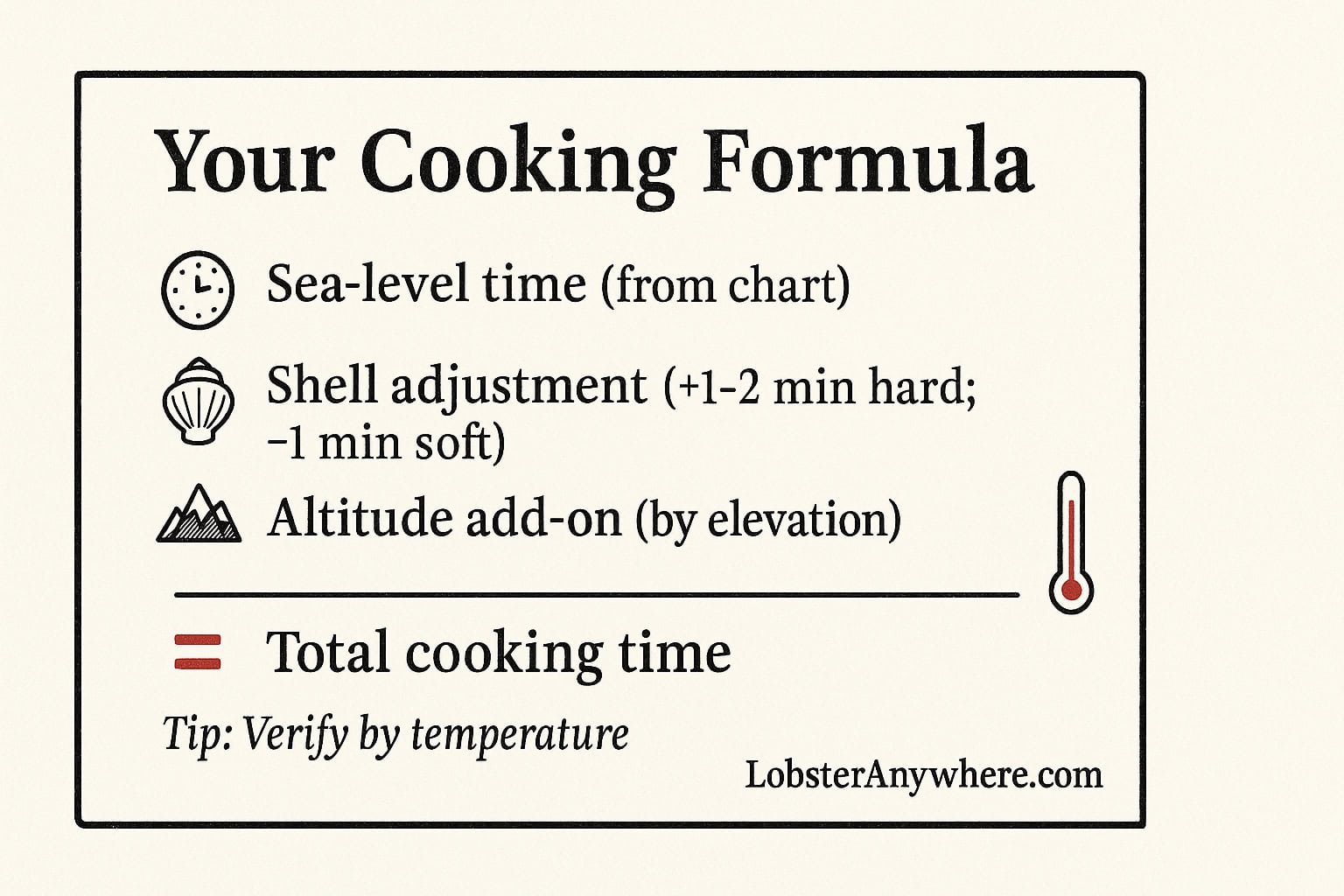
Tip: Start checking temperature about 2 minutes before the calculated finish; finish at 135–140°F (57–60°C). Start timing only after the boil/steam fully rebounds.
Example: 1.5 lb hard-shell at 5,300 ft (Denver)
- Sea-level: 9 min → +2 min (hard shell) → +2 min (altitude) = 13 min total
More Example Calculations
2.0 lb soft-shell lobster, steamed in Taos (7,000 ft):
- Sea-level: 13 min
- Soft shell: -1 min = 12 min
- Altitude: +3 min = 15 min total
- Start temp-checking at 13 minutes
High-Altitude Boiling: Step-by-Step
- Choose your pot: Use a large pot filled about ¾ full—this ensures the boil rebounds quickly after loading lobsters. See our pot size guide for recommendations.
- Salt and heat: Add salt for flavor (approximately two tablespoons per quart / ~30–36 g/L, depending on the salt grain). Bring to a hard, rolling boil with the lid on.
- Load headfirst: Place lobsters headfirst into the pot. Cover immediately with a tight lid.
- Start timing correctly: Begin your timer only when the water returns to a full, vigorous boil (usually 2–4 min after loading). This can take 2–4 minutes, depending on pot size and number of lobsters. Between batches: Wait for a full boil rebound before starting the next timer.
- Check temperature early: Start checking the internal temperature about 2 minutes before your calculated finish time. Insert the thermometer into the thick tail joint.
- Rest briefly: Let rest 3–5 minutes. Carryover cooking brings it to ~140–142°F (60–61°C).
⚠️ #1 Boiling Altitude Mistake: Starting your timer before the water returns to a boil. Always wait for the vigorous boil to resume after loading lobsters.
Need the fundamentals? See the complete Boil Lobster Guide.
High-Altitude Steaming: Step-by-Step
- Set up steamer: Add 2 inches of water to the pot. Place the steamer rack so that the water sits below it. Cover with a tight-fitting lid.
- Bring to strong boil: Heat until you see vigorous steam escaping from the lid edges.
- Load lobsters: Place lobsters on the rack. Cover immediately.
- Start timing: Begin timing only when steam is visibly active again after loading (usually 1–2 minutes). Between batches: Wait for vigorous steam to return before starting the next timer.
- Use the same altitude add-ons: Apply the same altitude time additions as boiling (from the steaming baseline in the table).
- Temp-check early: Start checking 2 minutes before the calculated finish. Pull at 135–140°F (57–60°C).
- Rest briefly: Allow 3–5 minutes rest time.
⚠️ #1 Steaming Altitude Mistake: Starting your timer before steam returns to full strength. Always wait for vigorous steam after loading lobsters.
Steaming advantage: Easier to maintain vigorous heat with a sealed lid, and lobsters don’t sit in water.
New to steaming lobster? See the full How to Steam Live Lobsters.
Maine Lobster Tails at High Altitude
Quick Size & Time Reference — Tails
| Tail Size | Sea-Level Time (Boil/Steam) | Add for Altitude |
|---|---|---|
| 4–6 oz | 6–8 min | +1–4 min (by elevation) |
| 6–8 oz | 8–10 min | +1–4 min (by elevation) |
| 10–12 oz | 10–12 min | +1–4 min (by elevation) |
Use with baselines: Add altitude minutes after shell-hardness adjustments (+1–2 min hard-shell, −1 min soft-shell). Start timing only after boil/steam fully rebounds. Tip: Start checking ~2 minutes before the calculated finish; finish at 135–140°F (57–60°C). Need prep steps? See How to Cook Lobster Tails (split or butterfly).
Dry heat (bake/broil/grill): Brush with butter/oil; consider a loose foil tent; still finish at 135–140°F (57–60°C).
For complete tail cooking instructions, see our lobster cooking guide.
Moist Heat (Boil/Steam)
Apply the same altitude adjustments as whole lobsters. Use the chart above to determine sea-level baseline times, then add the corresponding minutes based on your elevation.
Example: 6 oz tail, steamed at 5,000 ft
- Sea-level time: 6–8 min
- Altitude adjustment: +2 min
- Total: 8–10 min
- Pull at 135–140°F (57–60°C)
Dry Heat (Bake/Broil)
Oven temperature is the same whether you’re in Aspen or Boston—air pressure doesn’t affect oven heat. No time adjustment needed, but protect moisture.
Tips for baking/broiling tails at altitude:
- Brush with butter, consider a loose foil tent if the surface dries, and pull at 135–140°F (57–60°C)
- Check for surface drying—mountain air is drier
- Still finish by thermometer: 135–140°F (57–60°C)
Example: 8 oz tail, baked at 425°F (218°C) in Lake Tahoe (6,200 ft)
- Time: 12–15 min (no altitude adjustment)
- Baste with butter halfway through
- Pull at 135–140°F (57–60°C)
What About Salt? Won’t That Help?
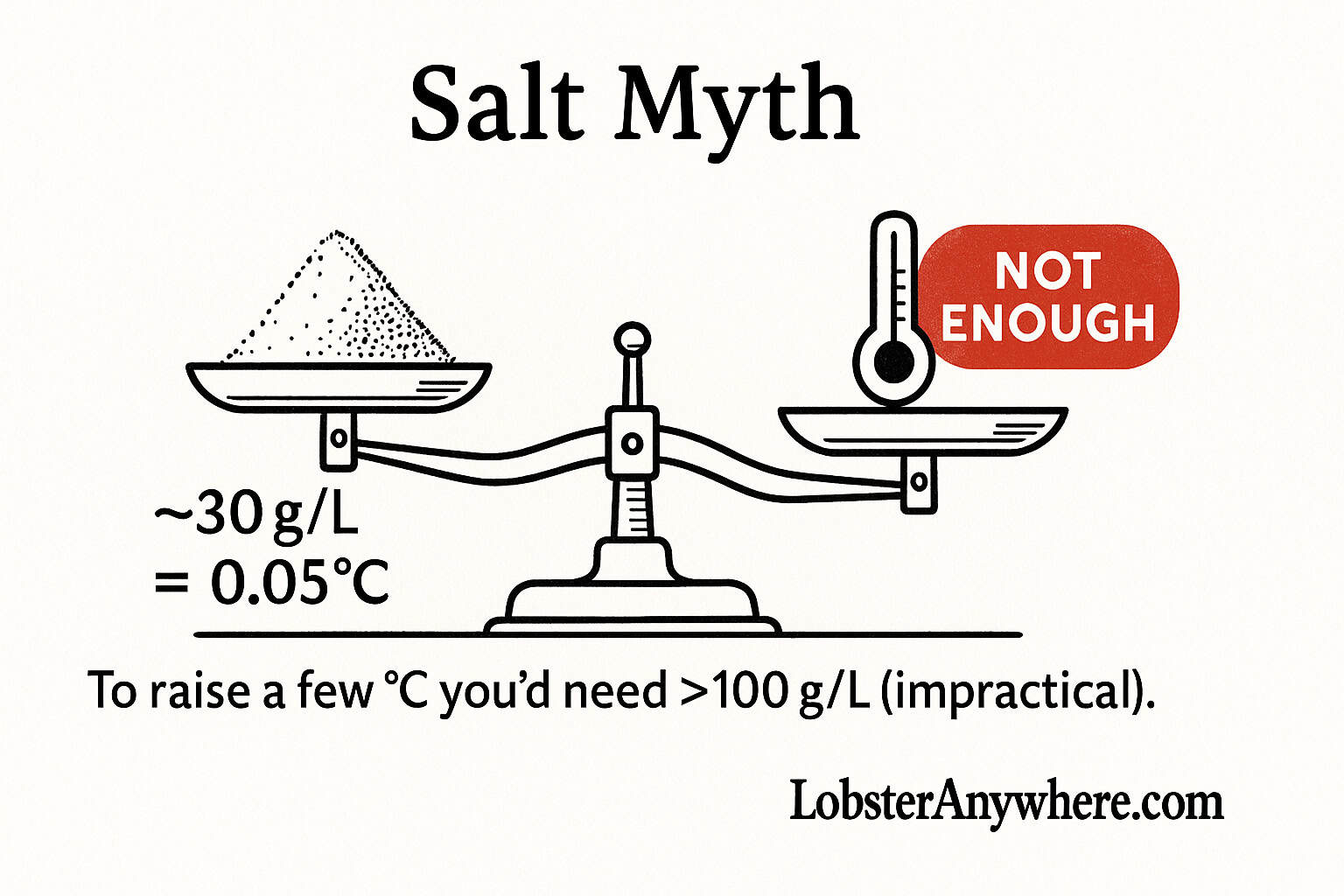
Salt raises the boiling point only minimally at culinary levels. You’d need about 30 grams of salt per liter to raise the boiling point by just 0.5°C (~1°F). To gain a few degrees, you’d need over 100 grams per liter—impractically salty and still insufficient to offset altitude effects.
Bottom line: Season your water for flavor, not temperature. Salt won’t solve the altitude challenge.
Pressure Cookers at Altitude
Pressure cooking raises the boiling temperature inside the pot, which is why pressure canners require higher PSI at higher elevations. While this technique works for lobster, we generally don’t recommend it—the texture can turn mealy very quickly under pressure.
If you experiment with pressure cooking lobster at altitude, test with small batches and check the temperature aggressively every 30–60 seconds once you think it’s close.
Troubleshooting & Pro Tips
Problem: Boil drops and stays weak after loading lobsters
- Solution: Reduce batch size or switch to steaming. A covered pot of steam maintains temperature better than a struggling boil when you cook lobster at altitude. Don’t start your timer until you have vigorous boiling or steaming.
Tip: Keep the lid on
- More water means more thermal mass, which stabilizes the boil when cold lobsters are added to the pot. The boil rebounds faster. A pot filled about ¾ full works best. See our pot size guide for recommendations—especially important for How to Cook Large Lobsters (3–10 lb).
- At altitude, evaporation occurs more rapidly due to lower air pressure and drier air. A tight lid retains both heat and moisture when you steam lobster at high altitude.
Tip: Bigger pot = better results
- More water means more thermal mass, which stabilizes your boil when cold lobsters hit the pot. The boil rebounds faster. A pot filled about ¾ full works best. See our pot size guide for recommendations, especially important for large lobsters (3–10 lb).
Tip: Shell hardness matters
- Hard-shell lobsters have thicker shells that insulate the meat, requiring 1–2 extra minutes. Soft-shell lobsters cook faster—subtract about 1 minute before adding altitude time.
Tip: Don’t overcrowd
- Cook in batches if needed. Too many lobsters at once can drop the temperature dramatically and unpredictably extend lobster cooking time in Denver or other high-altitude cities.
Tip: Use a reliable instant-read thermometer
- This is your most important tool at altitude. Time is a guide; temperature is the truth. Check out LobsterAnywhere lobster tools for recommended thermometers.
Common Altitude Mistakes (And How to Fix Them)
❌ Starting timer before boil returns → ✅ Wait for vigorous boil/steam to resume (see boiling steps)
❌ Leaving lid off → ✅ Keep pot covered to retain heat and moisture (see troubleshooting tips)
❌ Overcrowding the pot → ✅ Cook in batches; use a larger pot with more water (see pot size guide)
❌ Skipping the thermometer → ✅ Always temp-check at 135–140°F (57–60°C) for perfect texture (see finish by temperature)
❌ Cranking up the heat → ✅ Add minutes, not temperature—water still boils at the same (lower) temp.
High Altitude Lobster Cooking FAQ
Why does water boil at a lower temperature at altitude?
Lower atmospheric pressure at altitude means water molecules need less energy to escape as vapor, so water boils at a lower temperature—about 1°F lower per 500 feet of elevation gain. This is why moist-heat cooking methods (boiling and steaming) require extra time at higher elevations.
Is steaming better than boiling at altitude?
Either method works well. Steaming is often easier to keep vigorous with a tightly sealed lid, but the steam itself is still at your local boiling temperature—so you’ll still need to add time for altitude. Some cooks find steaming more forgiving because it’s less sensitive to batch size when you cook lobster at altitude.
Does altitude change lobster tail baking time?
No—oven temperature isn’t affected by air pressure. Use normal baking times, but protect moisture with butter or oil and finish by temperature (135–140°F / 57–60°C). The drier mountain air can speed surface drying, so brush tails generously and consider a loose foil tent.
Can I grill lobster tails at altitude?
Yes—treat grilling like broiling. No time adjustment needed since grill temperature isn’t affected by air pressure. Protect moisture by brushing with butter or oil, consider a loose foil tent if direct heat is too intense, and finish by thermometer at 135–140°F (57–60°C). The drier mountain air can dry surfaces faster, so baste once or twice during cooking.
How much more time do I need at 5,000 feet?
Plan for roughly 2–3 extra minutes for a typical 1.5 lb lobster. This aligns with extension service guidance that simmered meats need about 25% more time at 5,000 feet. Always verify doneness with a thermometer rather than relying solely on the clock.
Do ovens work the same at high altitude?
Yes—air pressure doesn’t change how a 425°F (218°C) oven heats. However, drier mountain air can speed surface drying, so brush lobster tails with butter or oil and monitor closely. Finish by internal temperature (135–140°F / 57–60°C), not time alone.
What if I don’t have a thermometer?
Visual cues can work but are less reliable at altitude. Look for meat that’s opaque white (not translucent) throughout, and shells that are bright red. The tail should curl slightly but not tightly. When in doubt, invest in an instant-read thermometer from LobsterAnywhere lobster tools—it’s the single best tool for consistent results.
Can I use these adjustments for lobster claws sold separately?
Yes. Apply the same altitude time add-ons. Claws are denser than tails, so they may need an extra minute or two. Always check with a thermometer in the thickest part of the claw meat.
Does this work for other shellfish at altitude?
The principles apply—shrimp, crab, and mussels all need slightly more time when boiled or steamed at altitude. However, these cook much faster than lobster, so the adjustments are smaller (usually +30 seconds to +1 minute). Temperature checking is still your best guide.
Quick Recap
- Water boils cooler at altitude—expect 203°F at 5,000 ft instead of 212°F
- Add time for moist-heat methods—+1-4 min depending on elevation
- No time adjustment for baking/broiling—but watch for dryness
- Always finish by temperature—135-140°F in the tail joint
- Keep the lid on—prevents heat and moisture loss
- Start timing when the boil/steam returns—not when you drop the lobsters in
Sources & Additional Reading
- FoodSafety.gov — Safe Minimum Cooking Temperatures (seafood guidance at 145°F / 63°C).
- U.S. FDA — Selecting & Serving Fresh and Frozen Seafood Safely (consumer seafood safety tips).
- Colorado State University Extension — Effect of Altitude on Food Preparation (boiling-point & high-altitude adjustments).
- Utah State University Extension — Principles of Pressure Canning (why pressure/boiling behaves differently at elevation).
- Complete lobster cooking guide — Lobster Cooking Times & Temperatures Guide (Boil vs. Steam)