
The scallop is one of the sea’s most fascinating creatures — a fan-shaped bivalve with a rich history in art, religion, and culture, and one of the finest seafood delicacies the ocean has to offer. Below you’ll find scallop facts covering everything from biology and nutrition to the surprising role this humble shell has played throughout human history.
Scallops in History, Religion, and Art
In the Middle Ages, the scallop shell was a holy symbol worn on the cloaks of pilgrims traveling to the shrine of Saint James the Apostle, a fisherman from Galilee. According to legend, Saint James’ body was lost at sea on the way to Spain for burial. Miraculously, it washed ashore undamaged and covered in scallops. The shells were said to signify the love of God and one’s neighbor, and the ridges to represent the good works pilgrims would perform on their return. In honor of Saint James, the French named scallops Coquilles St. Jacques — “Seashells of Saint James.”

Perhaps the most recognized depiction of the scallop in Western art appears in Botticelli’s The Birth of Venus. In this celebrated Italian Renaissance painting, Venus drifts to shore atop the half shell of a scallop, moved by the breath of Zephyrus. You can see the original at the Uffizi Gallery in Florence, Italy.
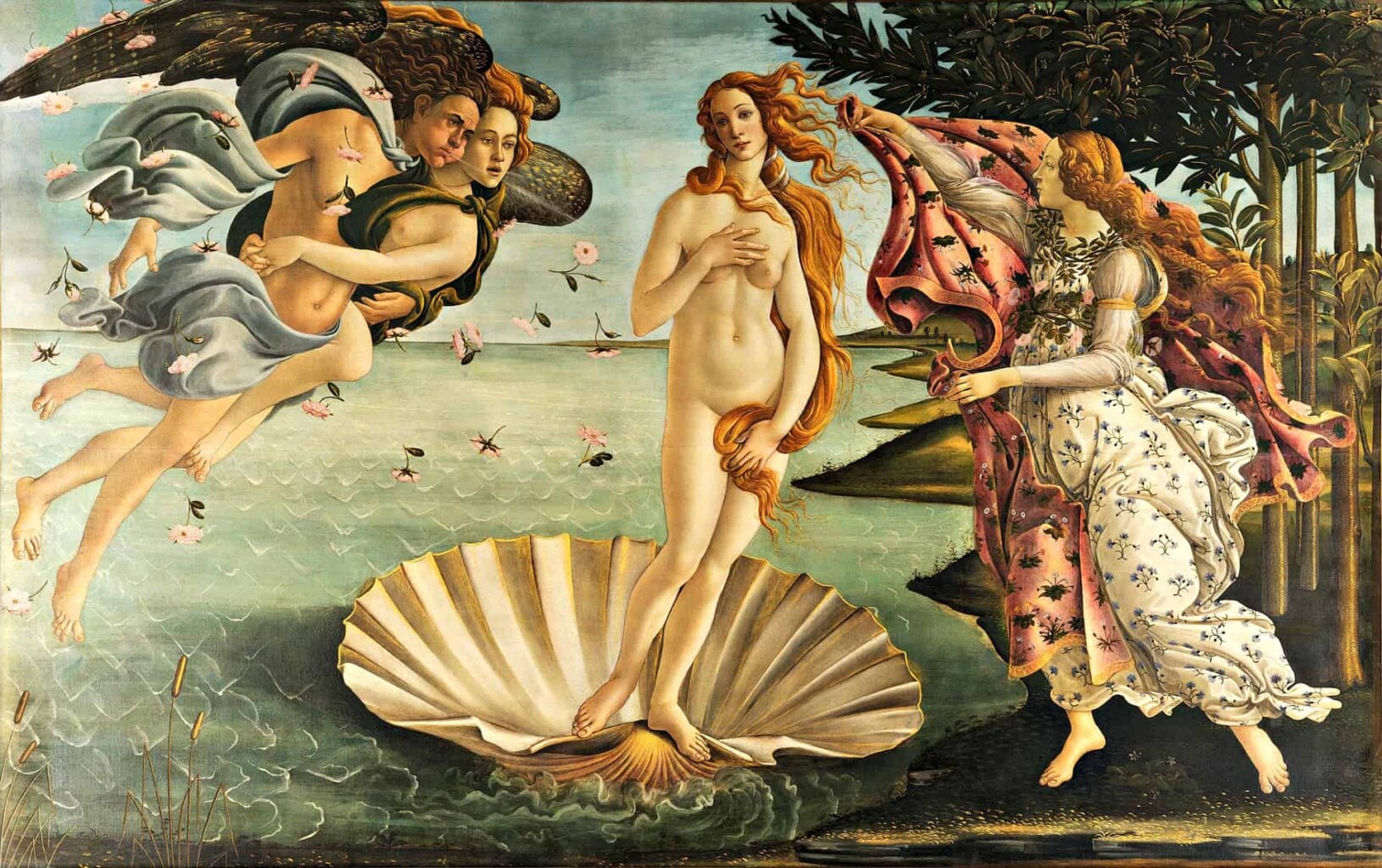
(1485). Credit: Google Art Project
The scallop shell also left its mark on ancient Rome — appearing in the architecture of Pompeii and on Roman gravestones and caskets. Today, the iconic Shell Oil logo is a modern rendering of the Great Scallop (Pecten maximus).

How Many Species of Scallops Are There?
There are more than 400 species of scallops found in oceans around the world. They belong to the family Pectinidae and are found in all of the world’s oceans, from shallow coastal waters to deep-sea environments. In North America, the two most commercially significant species are the Atlantic sea scallop (Placopecten magellanicus), harvested along the Eastern Seaboard, and the bay scallop (Argopecten irradians), found in shallower coastal waters and estuaries.
Why Scallops Are Considered Clean Shellfish
Scallops are widely regarded as one of the cleanest shellfish you can eat. Unlike clams, oysters, and mussels, which filter large volumes of water through their entire bodies, scallops feed primarily through their abductor muscle — the part you actually eat. Because that muscle is not used to filter water, scallops are far less likely to accumulate the toxins and contaminants that affect other bivalves. It’s one of the reasons scallops are so consistently mild, sweet, and approachable even for people who are cautious about shellfish.
Top Sea Scallop Ports in the U.S.
The United States is one of the world’s largest producers of sea scallops, with most of the commercial harvest coming from the Mid-Atlantic and New England coasts. The top ports include:
- New Bedford, Massachusetts — consistently the highest-volume scallop port in the country and one of the most valuable fishing ports in the U.S. by dollar value
- Cape May, New Jersey — a major Mid-Atlantic landing port with a strong commercial scallop fleet
- Norfolk, Virginia — another significant Mid-Atlantic port serving the offshore scallop fishery
Scallop or Skawl-up?
The coastal New England states, particularly coastal Maine, Massachusetts, and Rhode Island, have their own way of enunciating the word scallop – ‘skal-lup’ –while inland folks and the remaining Northeast states pronounce it with an accent ‘skawl-up.’ Both are acceptable, but the way that a person pronounces the word will surely give away their place of origin!
Do Scallops Swim?
Half the battle when catching scallops for a seafood dinner is finding them. Bay scallops camouflage themselves in thick beds of grass that are about 4-8 feet of water close to the shoreline. They can be difficult to find, but they have three characteristics that stand out:

- They swim or jump or something: Scallops are the swiftest of the bivalves. By quickly opening and closing their shells, they use their meaty abductor muscle like a jet engine to propel themselves through the water. If you get close enough to a bed of sea grass underwater, you can watch bay scallops pop up and flitter off.
- Open wide: Often referred to as filter feeders, they usually keep their mouths open to catch food particles and plankton filtering through.
- Stunning blue eyes and lots of them: Another scallop trait is its eyes, which look like a series of bright blue and turquoise gems along the edge of its shell. There are about 50 on average on a scallop, but they can only detect movement and light.
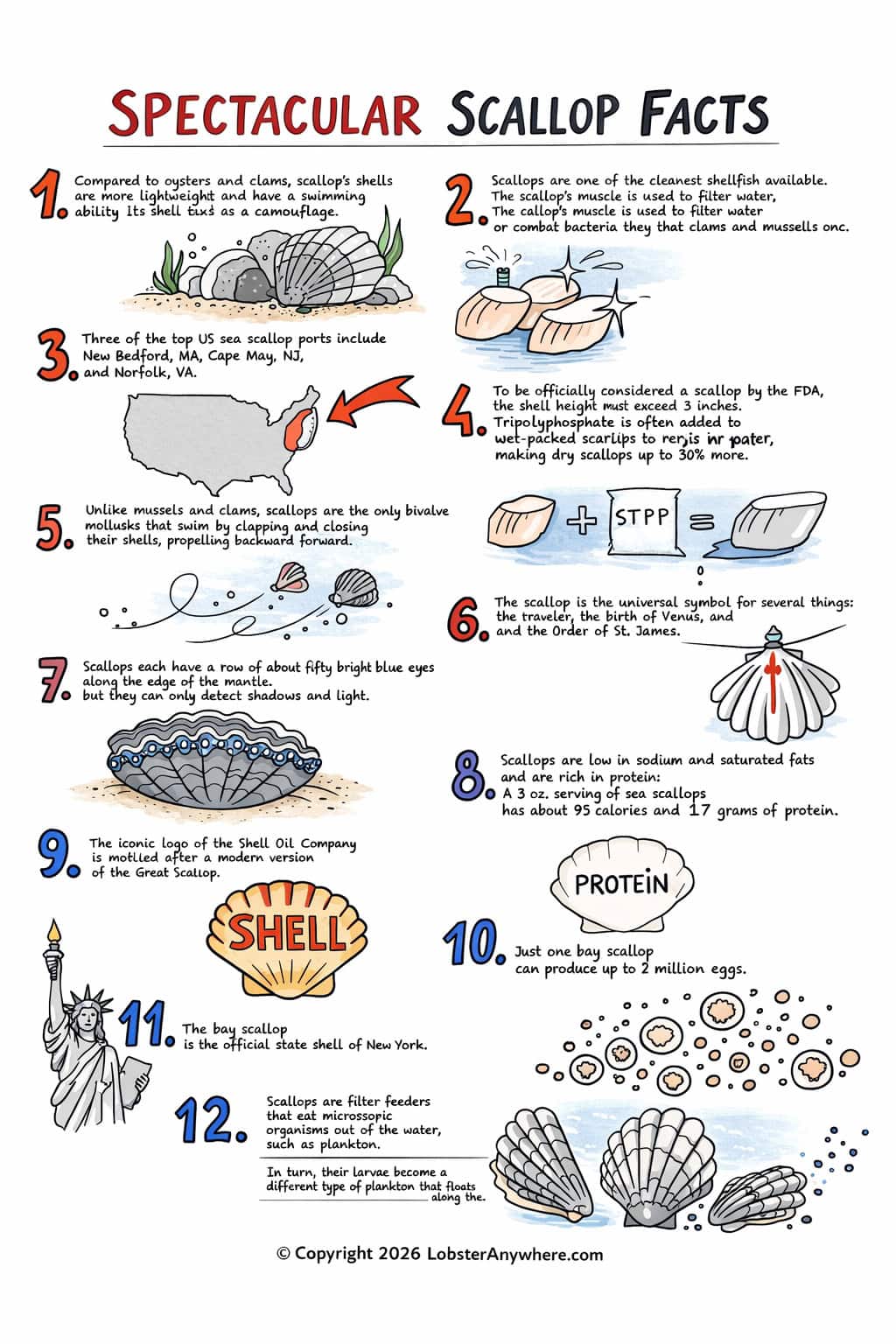
- Free-Swimming — Scallops are the only free-swimming bivalve mollusk. By rapidly opening and closing their shells, they use their powerful adductor muscle like a jet engine to propel themselves through the water.
- Built for Camouflage — Compared to oysters and clams, scallops’ shells are thin and lightweight, which aids in swimming. Since scallops can’t dig like clams, their shells also act as camouflage.
- 400+ Species — There are more than 400 species of scallops found in oceans around the world. In North America, the two most commercially significant are the Atlantic sea scallop and the bay scallop. Learn more about the difference between sea scallops and bay scallops.
- 50 Blue Eyes — Each scallop has a row of about 50 bright blue eyes along the edge of its shell, but they can only detect movement and light.

- Naturally Clean — The adductor muscle — the part you eat — is not used to filter water, making scallops far less susceptible to toxins and contaminants than clams, mussels, or oysters.
- What Scallops Eat — Scallops are filter feeders that eat small organisms and plankton filtered through the water. Their color can vary depending on the types of plankton they consume.
- FDA Moisture Standard — To be officially considered a scallop by the FDA, its moisture content must be less than 80%. STP (sodium tripolyphosphate) is often used by lower-quality suppliers to plump up scallops, sometimes by up to 30%. Learn how to identify and avoid treated scallops.
- Top U.S. Ports — Three of the top U.S. sea scallop ports are New Bedford, MA; Cape May, NJ; and Norfolk, VA.

- Nutrition — Scallops are low in sodium and saturated fats and are an excellent source of protein. A 3.5 oz. serving of untreated sea scallops has about 88 calories, 0.8 g of fat, and 17 g of protein.
- The Shell Oil Logo — The iconic Shell Oil logo is a modern rendering of the Great Scallop (Pecten maximus). The landmark Shell sign at 187 Magazine St. in Cambridge, Massachusetts, is one of the most recognized versions of the logo in New England.

- Reproduction — Most bay scallops are hermaphrodites — they have both male and female sex organs — while sea scallops have separate sexes.
- Prolific Spawners — Just one bay scallop can produce up to 2 million eggs.
- New York State Shell — The bay scallop is the official state shell of New York.
- Diver Scallops — Diver scallops are hand-picked one by one from the ocean floor rather than harvested by dragging heavy nets. Learn more about what makes diver scallops different.



Now that you are an expert on scallop facts, cook some beautiful dry scallops at home today!
See Also: Scallop 101: All About Scallops
Got scallops? Order some of the best sea scallops anywhere online!
To me, Scallops have the best flavor, yet so many ppl won’t eat them!
I know that tastes differ, and there will be
more me. I need some now!!