
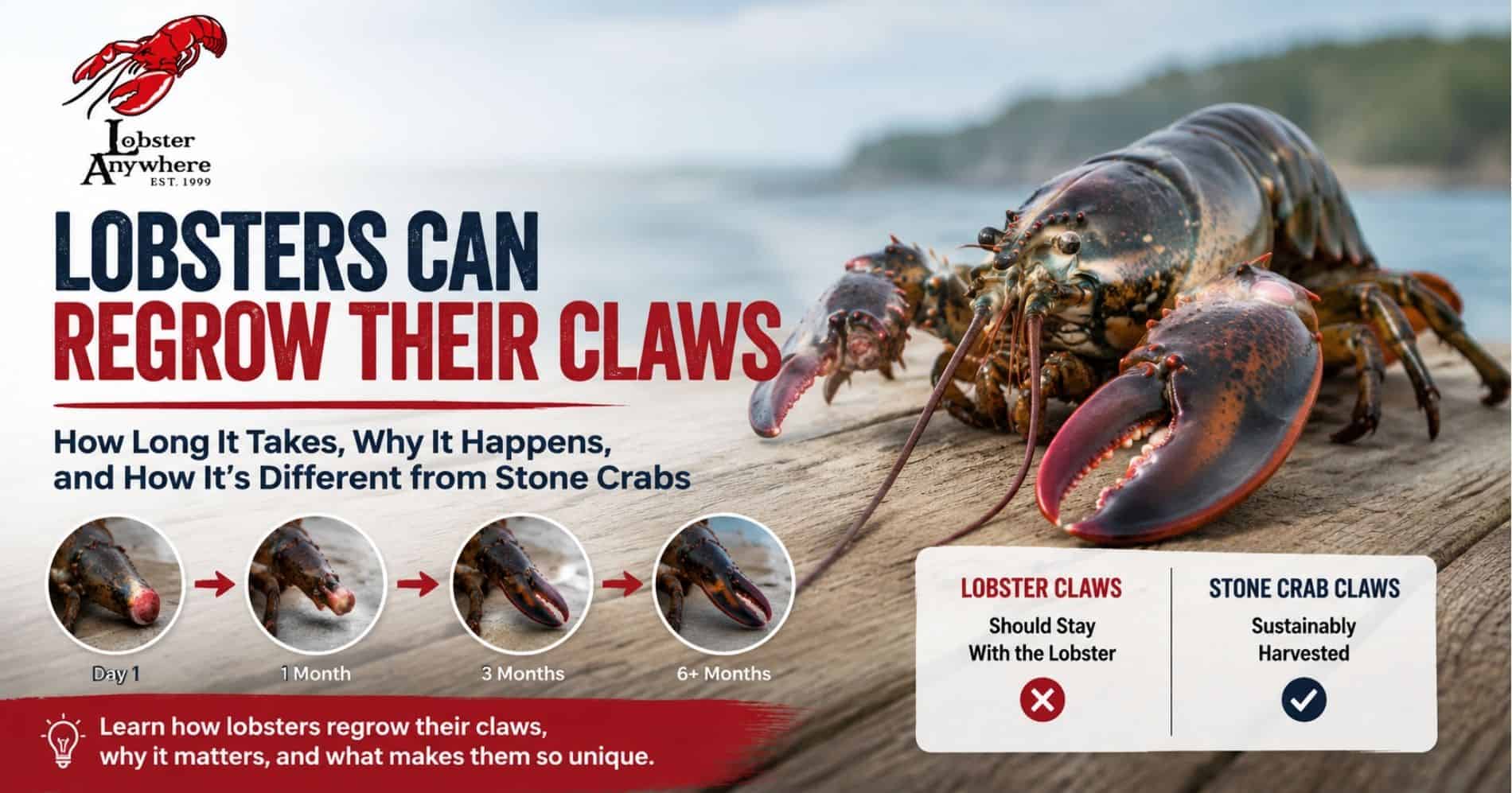
A question that comes up from time to time is if a lobster can regrow its claws. The answer is yes, lobsters do regenerate their claws, but it can take five years for adults as the process occurs during the molting season. While younger lobsters molt more frequently, so their claws grow back faster, they aren’t as big so the meat yield would not be sufficient if this was to be for sustainable harvesting. Taking the claws off the lobster is a question that comes up regularly because of similar crustaceans like stone crabs where the claws are harvested and then the crab is tossed back into the ocean alive.
Stone crabs can regenerate their claws in about 12 to 18 months time (one year on average for adults), but unlike lobsters, stone crabs are protected animals so it is prohibited by law like this one in Florida to harvest the entire animal where lobsters are allowed to be harvested whole.
These same regulatory bodies prohibit taking the claws off of the lobster and then tossing them back into the ocean even though the lobster can regenerate them. Fishers must keep the lobster’s body whole at least until they’re brought to port.
Fun fact: A lobster that is caught naturally but is missing a claw is called a “cull” and is allowed to be harvested as it was through a natural process. But without the claw there is less meat, so the lobster won’t sell for as high of a price.
While culls are somewhat common, there are studies about returning the cull lobsters to the ocean as a sustainability practice. The studies have gone into great detail including seeing if there is a difference between this for male and female lobsters. This one even mentions releasing culled lobsters as a way to help increase egg production.
Both crustaceans will drop their claws as a natural defense mechanism, which is another one of the reasons people ask if harvesting lobster claws only could be a sustainability practice. But a lobster losing its claws without intending to will be mostly defenseless, and the process may cause unnecessary trauma.
In the wild lobsters will sometimes self-amputate a claw via a process called autotomy to deter a predator or sometimes to fight another lobster. The limb will remain missing until the next molting cycle where a new hard shell begins to form. Then after a few molting cycles the new claw will be at the same size as the existing one would have been. But this isn’t without its own issues.
The claws are some of the hardest limbs for the lobster to remove from their shell during a molt, and from time-to-time the new limb will get stuck in the claw being molted causing the lobster to have to start the process over again. It’s similar to wearing tight gloves over your hands, you have to pull them off and sometimes wiggle each finger out individually as gloves can be tight.
Fun fact: As the molting process begins, the lobster will reduce the amount of blood in the claws causing the flesh to shrink. This makes it easier to get out of the shell being molted.
In addition to regenerating their claws, both claws serve a different purpose. One is a crusher used to open food like clams, mussels, and crabs, and a pincher claw to rip apart softer foods like fish. If the crusher claw (the larger one) is the one that is dropped, the pincher claw will begin growing to take its place in size and function during the molting cycles, and the new claw will become the pincher.
While lobsters can regrow their claws, harvesting claws and tossing the lobster back into the ocean like a stone crab is not a good practice and may be illegal depending on where you fish. Unlike the stone crab which will grow their claws back quickly, it could easily be five years before the lobster has a usable claw making it more dangerous for them to live in the ocean. And that is why we don’t harvest lobster claws like stone crabs as a sustainability practice.