
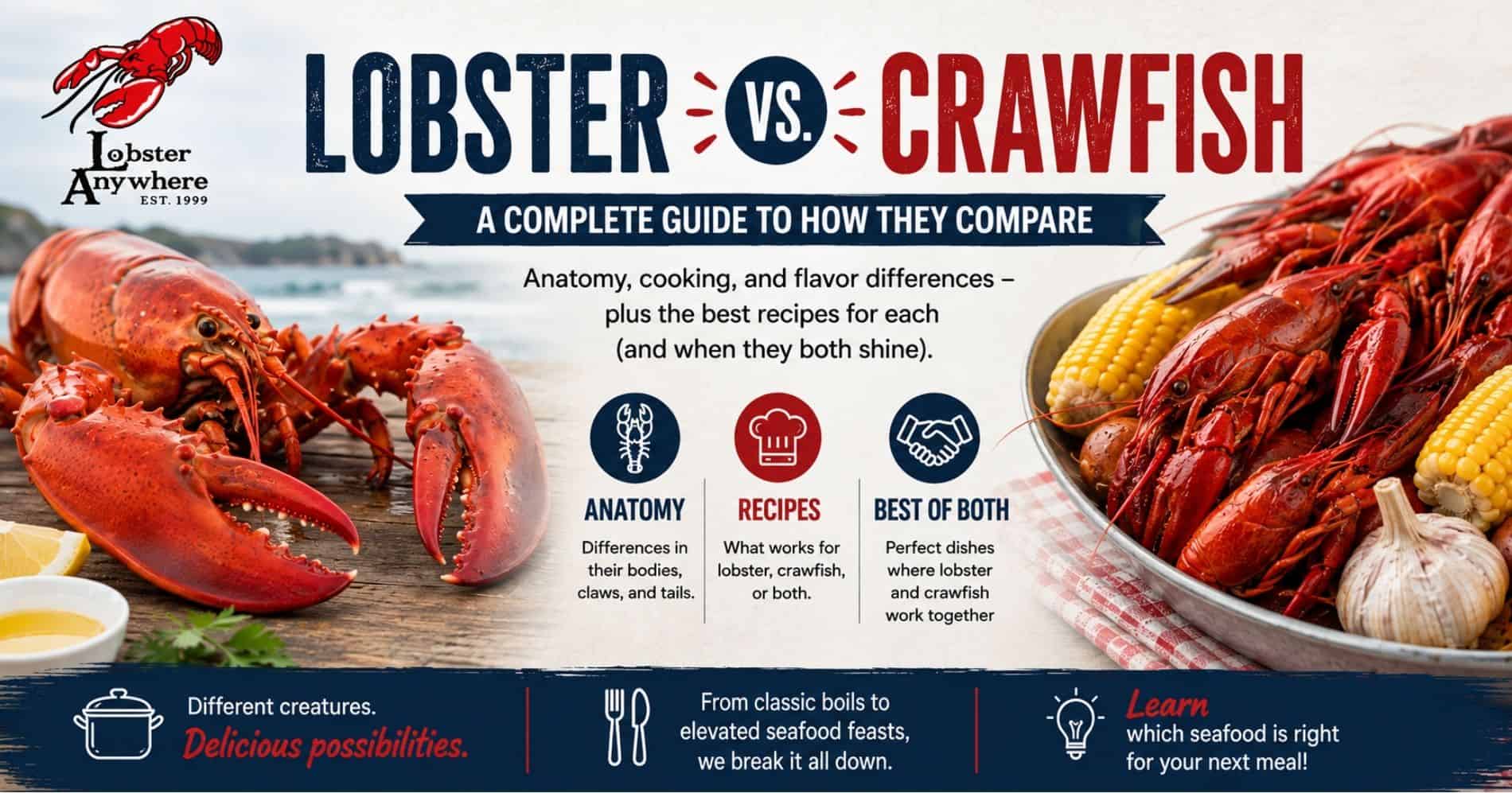
While crawfish may look like little Maine Lobsters as both have claws and cook red, they’re very different. There are more than 640 estimated species of crawfish, while there are only 145 to 260 (depending on the scientist’s classification) of lobsters. While all healthy adult crawfish have claws, many species of lobster do not have claws, including the Caribbean spiny lobster.
If you’re curious about how lobsters and crawfish compare, are looking for recipes that incorporate both because their flavors mesh with spices, or just want some fun facts, we share all of this information and more below. Since we are a lobster company, we’ll start with taste and recipes.
The Differences in Taste
While these two crustaceans look similar, they taste very different and cannot be interchangeable in many dishes. This is in part due to where they live with lobsters in the ocean and crawfish being fresh and brackish water animals leading to different tastes. In addition to their living environments, the meat yield makes it difficult to substitute crawfish from lobsters in some dishes, and allows you to extract more flavors from lobsters with each bite.
- Lobsters live in the ocean, so they bring a salty, briny taste along with a buttery texture and a firm bite.
- Crawfish come from freshwater and tend to be sweeter with a milder crustacean flavor.
Fun fact: Crawfish have a taste more similar to crab than to lobster, due to crab living in brackish water and being a crustacean and lobsters living in the ocean.
Lobster and crawfish meat taste great with anything that complements natural acidity and fatty creams. This includes herbs like garlic, cheeses, and vinaigrettes. With lobster, you get a larger meat yield so it can handle big flavors like tarragon, which is perfect for pastas and traditional dishes like lobster thermador and lobster carbonara.
The big flavors overpower the tiny bites from a crawfish, so you’ll want to look for food items that enhance or complement the crawfish vs. taking away from it. This includes andouille sausage, meals that get a heavy handed helping of cayenne pepper (lobster only requires a little), and bell peppers that mask the natural brine of the lobster. While some recipes do not allow the two to be interchangeable because of meat yield and ingredient compatibility, others work perfect.
Recipe Ingredients that Work With Both
For dishes where you can use both lobster meat and crawfish, look for ingredients and flavors that complement both like garlic, rice or pasta, butter, cayenne pepper, mayonnaise, and citrus fruits like lemon and lime. Here’s a few dishes that work with either or a combination of both.
- Scampi – The acidity from the white wine combined with the fatty butter and garlic works perfectly with both proteins, making it perfect for large, briny, and sweet tiny bites mixed with the pasta.
- Paella – Saffron pairs perfectly with both lobster and crawfish, so when you get the tiny bits of rice that complement the tiny bites of crawfish and hold the lobster, you have a winning dish.
- Classic cajun (etouffe, gumbo, po-boys) – Lobsters are sort of like giant crawfish tails when it comes to mixed dishes from the south, especially New Orleans. They pair perfectly flavor-wise and add a bit of extra brine, especially with dishes that could contain oysters or shrimp.
- Garlic fried rice – The garlic complements both proteins, and the rice is neutral and can absorb the briny but sweet flavor from both crawfish and lobster meat, making it the perfect combination.
- Cheese omelets – Fatty cheese and the textures balance each other out when it comes to lobsters, crawfish, cheeses, and eggs. And all three can do well with herbs like thyme or spices like cayenne pepper, letting you customize the omelet individually without having to make multiple different dishes.
- Cobb salad – This is the perfect place for both lobster and crawfish as the proteins like eggs and the fatty cheeses complement both flavor profiles. With a Caesar salad, the dressing overpowers both the crawfish and lobster meat making it not ideal.
- Macaroni and cheese – There’s a reason you see lobster mac and cheese at steakhouses and fine dining, and crawfish mac and cheese on the Gulf Coast, it is a timeless and delicious combination. The pasta and cheese absorb the flavors of the meats and bring the spices and seasonings to life by balancing them out.
Each of these has acidity, big creamy fats, and aromatics that bring out and complement the flavors. That makes them perfect whether you have leftovers from the night before, or you have extra crawfish or lobster tails sitting in the freezer and want something to do with them.
The Differences and Similarities Between Crawfish and Lobsters
The different species of lobsters and crawfish tend to be incredibly similar, so for the comparison, we’re going to use two of the most popular species, the Maine Lobster (Homarus Americanus) and the Louisiana Crawfish (Procambarus Clarkii).
Please note that the numbers and ranges below are averages, depending on the habitat, whether wild or farm-raised (Maine lobsters cannot be farm-raised for commercial food supplies), and environmental factors; each can and will change.
Fun fact: Both lobsters and crawfish have blue blood, just like horseshoe crabs, due to the copper-based hemocyanin.
Species and General Characteristics
These two may be crustaceans and have ten legs making them decapods, but they’re from different families and genus. Crawfish have much shorter lives as they may only live to 5 years old, while some scientists will say Maine lobsters can live up to 100 years. Here’s how they compare.
| Category | Louisiana Crawfish | Maine Lobster |
| Scientific Name | Procambarus Clarkii | Homarus Americanus |
| Family | Cambaridae | Nephropidae |
| Genus | Procambarus | Homarus |
| Order | Decapoda | Decapoda |
| Lifespan | 1 – 5 years | 30 – 50 years is the accepted number, some scientists will say up to 100. |
| Tail meat yield | Less than 1 oz | A few ounces to 1+ lbs |
| Wild color | Dark red to reddish-brown | Bluish-green to brown with red spines |
| Cooked color | Bright red | Bright red |
Differences in Anatomy
While they look the same which is why some people call crawfish “little lobsters”, they’re very different. In the wild crawfish will have a reddish-brown color while Maine lobsters will normally be a blue-green or brown and red hue. Crawfish will have a triangular Rostrum (the body part that looks like a beak between their eyes) and Maine lobsters have a pointed one.
On average, crawfish will range from 3.5 to 5 inches while a Maine lobster will reach 20 inches with crawfish coming in at less than 2 oz, and commercially caught lobsters up to 4lbs. Here’s more about their anatomy, where they’re similar and where they’re different down to the shapes of their claws (Maine lobsters have two sizes and crawfish have symmetric ones).
| Body part | Louisiana Crawfish | Maine Lobster |
| Overall size | ||
| Average length | 3.5 to 5 inches | 8 to 20 inches |
| Average weight | Under 2 oz | 1 to 4 lbs |
| Maximum recorded size | Up to 6 inches and 1.8 oz | 3 feet and 6 inches and coming in at 44 lbs |
| Walking legs | 4 pairs (8 legs) behind the claws, totaling 10 appendages | 4 pairs (8 legs) behind the claws, totaling 10 appendages |
| Hooks on legs | Reproductive hooks present on 3rd and 4th walking legs in mature males | No hooks; sexually differentiated by pleopod structure |
| Exoskeleton and Outer Structure | ||
| Exoskeleton | Hard chitinous shell that molts | Hard chitinous shell that molts |
| Carapace | Covers cephalothorax; smaller, narrower | Covers cephalothorax; larger, more elongated |
| Rostrum | Triangular, tapers to a point, no central keel | Pointed projection, often with spines on underside |
| Heads (Cephalon) | ||
| Antennae | Two long antennae, two short antennules | Two long antennae, two short antennules |
| Mandibles | Present, used for grinding food | Present, used for grinding food |
| Maxillipeds | Three pairs around the mouth for handling food | Three pairs around the mouth for handling food |
| Claws (Chelipeds) | ||
| Claw presence | One pair of claws (chelae) | One pair of claws (chelae) |
| Claw asymmetry | Claws relatively symmetrical and smaller; rows of red tubercles on inner margin | Two distinct claws including a crusher claw (large, blunt teeth) and a ripper/cutter claw (sharper edge) |
| Claw proportion | Smaller relative to body; less meat | Large and meaty; major source of edible flesh |
| Abdomen and Tail | ||
| Abdomen | Segmented, curved; dark red with a black dorsal stripe | Segmented, more elongated and muscular; large and meaty |
| Swimmerets (pleopods) | Present under abdomen; used for movement, reproduction, and egg-carrying in females | Present under abdomen; used for movement, reproduction, and egg-carrying in females |
| Telson and uropods | Fan-shaped tail (telson and uropods) used for rapid backward escape | Fan-shaped tail (telson and uropods) used for rapid backward escape |
| Internal and circulatory | ||
| Blood color | Blue (copper-based hemocyanin) | Blue (copper-based hemocyanin) |
| Gills | Feather-like gills within branchial chambers under carapace | Feather-like gills within branchial chambers under carapace |
| Digestive system | Stomach with gastric mill for grinding | Stomach with gastric mill for grinding |
Fun fact: While the largest Maine lobster caught in the world was 44lbs, the largest caught in Maine is 27lbs, was named Rocky, and released back into the ocean.
Both animals are crustaceans, and crawfish do look similar to the Maine lobster, but they are very different in size, have slight differences in anatomy, and where they live. This not only makes them taste different, but also determines which ingredients that can pair with and the dishes you can make with both or prepare separately. We hope you found this guide to lobsters and crawfish helpful, and if you’re craving dinner now, order our live lobsters or lobster meat packages.