
A lobster shares almost nothing with the animals we instinctively feel for. It does not cry out as there is no vocal chord. It has nothing like a mammal’s brain or a cerebral cortex allowing or learning, memories, or perception. For a long time, that was enough to settle the argument that whatever a lobster did in the pot was reflex, a response to heat or pressure, not anything it felt. So do lobsters feel pain? The answer is more complicated than most people expect.
That view has shifted. No one can climb inside a lobster’s head and prove what it experiences, but the research on decapod (10 legged) crustaceans including lobsters, crabs, shrimp, crayfish, and prawns has moved steadily toward caution. A growing number of scientists think these animals do more than react. They detect harmful stimuli, respond to injury, learn to avoid places where they were hurt, and in some studies, change their behavior when given pain-relief drugs.
So the honest answer is not a clean yes or no. Lobsters have not been shown to feel pain the way people do. But the evidence is strong enough that they should not be treated as simple reflex machines either. Since the remains open, the easy answer is to handle live lobsters for cooking gently, keep them cold, keep stress low, and cook or dispatch them quickly when the time comes.
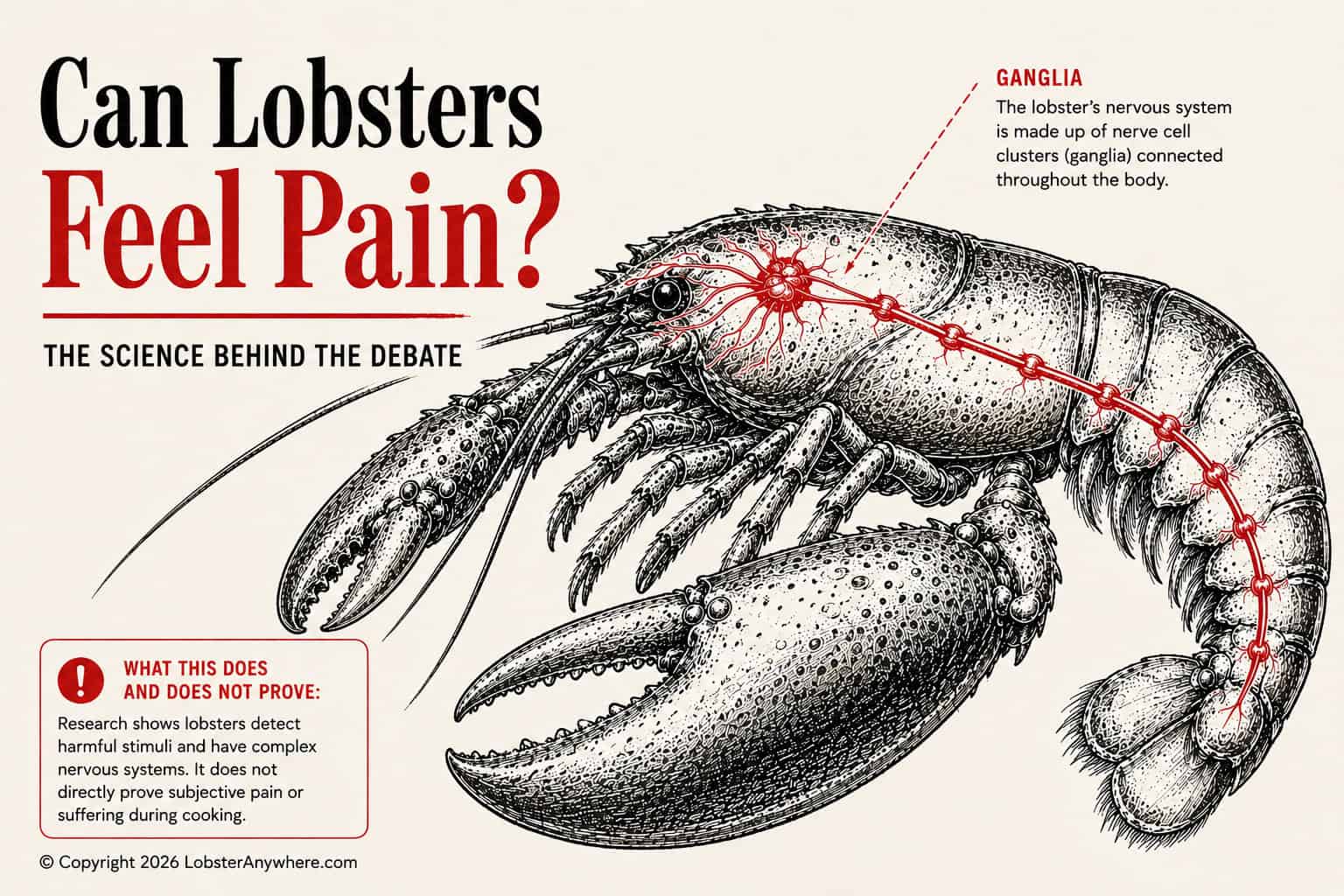
What this does and does not prove:
Research shows lobsters detect harmful heat and show central nervous system activity. It does not directly prove subjective pain or suffering during cooking. Stronger pain-like behavior studies often come from crabs, prawns, crayfish, or other lobster species, not Maine lobster.
The Short Answer
Maine lobster is the American lobster, Homarus americanus. It is a decapod crustacean, part of the same group now at the center of research on crustacean sentience.
A lobster clearly detects and reacts to harm, but nothing in the research proves it suffers the way a person does. That middle ground is why many scientists, welfare groups, and a handful of governments like the Italian government now recommend treating lobsters and other decapods as animals capable of pain or distress, even when the exact nature of that experience is impossible to pin down.
Pain in lobsters like the Maine lobster has not been directly demonstrated, but broader decapod evidence supports careful, respectful handling.
What’s Actually Inside a Lobster
It helps to know what a lobster is made of, because the lobster’s anatomy is exactly what makes the pain question hard. Lobsters belong to the phylum Arthropoda, alongside insects, crabs, barnacles, and shrimp. They wear their skeleton on the outside, a hard shell called an exoskeleton, with no bones inside.
They also lack a centralized brain of the kind mammals have. A lobster’s nervous system is spread out, built from roughly 15 clusters of nerve cells called ganglia distributed through the body, with the largest cluster sitting behind the eyes. By comparison with mammals, it is tiny and decentralized. A human brain runs on about 86 billion neurons; a lobster’s entire nervous system is a fraction of that.
That layout has visible consequences. Because nerve control is decentralized rather than funneled through one brain, parts of a lobster can keep moving briefly after it is split, driven by local circuits rather than anything the animal intends. It is also why a tail flip in hot water is not proof of felt pain on its own. It can be a local reflex.
This leads to the main part of the question, neurons and the decentralized nerve cells. Neuron count is not the whole story, since how neurons are wired together matters as much as how many there are. But that decentralized architecture is the main reason some researchers argue a lobster cannot have the unified, conscious experience that pain in the human sense seems to require.
The Difference Between Feeling Pain and Reacting to It
Most of the confusion comes down to one distinction, how the nervous system responds to stimuli.
Nociception is the nervous system detecting something harmful (heat, pressure, acid, tissue damage) and firing off a response, like pulling away. Pain goes a step further. In welfare terms, pain is an unpleasant felt experience, something the animal is consciously aware of.
You can have nociception without pain, and a reflex by itself proves nothing. So researchers do not hang their case on a single twitch or tail flutter. They look for a cluster of behaviors that are hard to explain as pure reflex. The criteria below are the ones used in recent reviews of decapod sentience.
| What researchers look for | What it means in plain terms |
|---|---|
| Nociceptors | The animal can detect harmful stimuli. |
| Integrative nerve centers | The nervous system can process information, not just react locally. |
| Connections between sensors and processing areas | Harmful signals can reach parts of the nervous system involved in coordination. |
| Response to anesthetics or analgesics | Pain-relief drugs change the animal’s reaction. |
| Motivational trade-offs | The animal weighs a threat against a reward, such as shelter or food. |
| Self-protective behavior | The animal guards, rubs, or grooms a specific injured area. |
| Associative learning | The animal learns to avoid places or situations linked to harm. |
| Valuing pain relief | The animal seeks or prefers conditions associated with relief after injury. |
No single line of evidence proves sentience, but when several happen together, saying it is only a reflex gets harder to defend.
The Reason Some Researchers are Skeptic
Not every researcher is convinced that lobsters don’t feel pain, and it is worth knowing why before weighing the evidence on the other side.
The skeptical case rests on the anatomy with no centralized brain, a decentralized chain of ganglia, and only a sliver of the neurons a mammal carries. With this in mind, the tail flip in hot water is a reflex from local nerve circuits, not a sign of suffering. Joseph Ayers, a biologist who studies lobster neurobiology at Northeastern University, has been quoted making the skeptical case that lobsters lack the neural hardware needed for pain in the human sense. This view says a lobster may pull away from heat or injury without actually feeling pain the way a person would.
This is a serious scientific position from an acclaimed marine scientist, not a cook’s excuse. The counterpoint, which has been gaining ground, is that the lack of a mammal-like brain no longer counts as proof of no pain. Different nervous systems can reach similar capabilities by different routes, and the behavioral evidence has grown harder to brush aside. That’s why there’s no real answer, only the results of the studies that let us decide for ourselves.
What Lobster Pain Studies Actually Show
Here is what direct research on lobsters feeling pain actually shows.
| What you’ll read online | What the evidence actually supports |
|---|---|
| “Lobsters feel pain.” | This is not directly proven as no study has shown subjective pain in this species. |
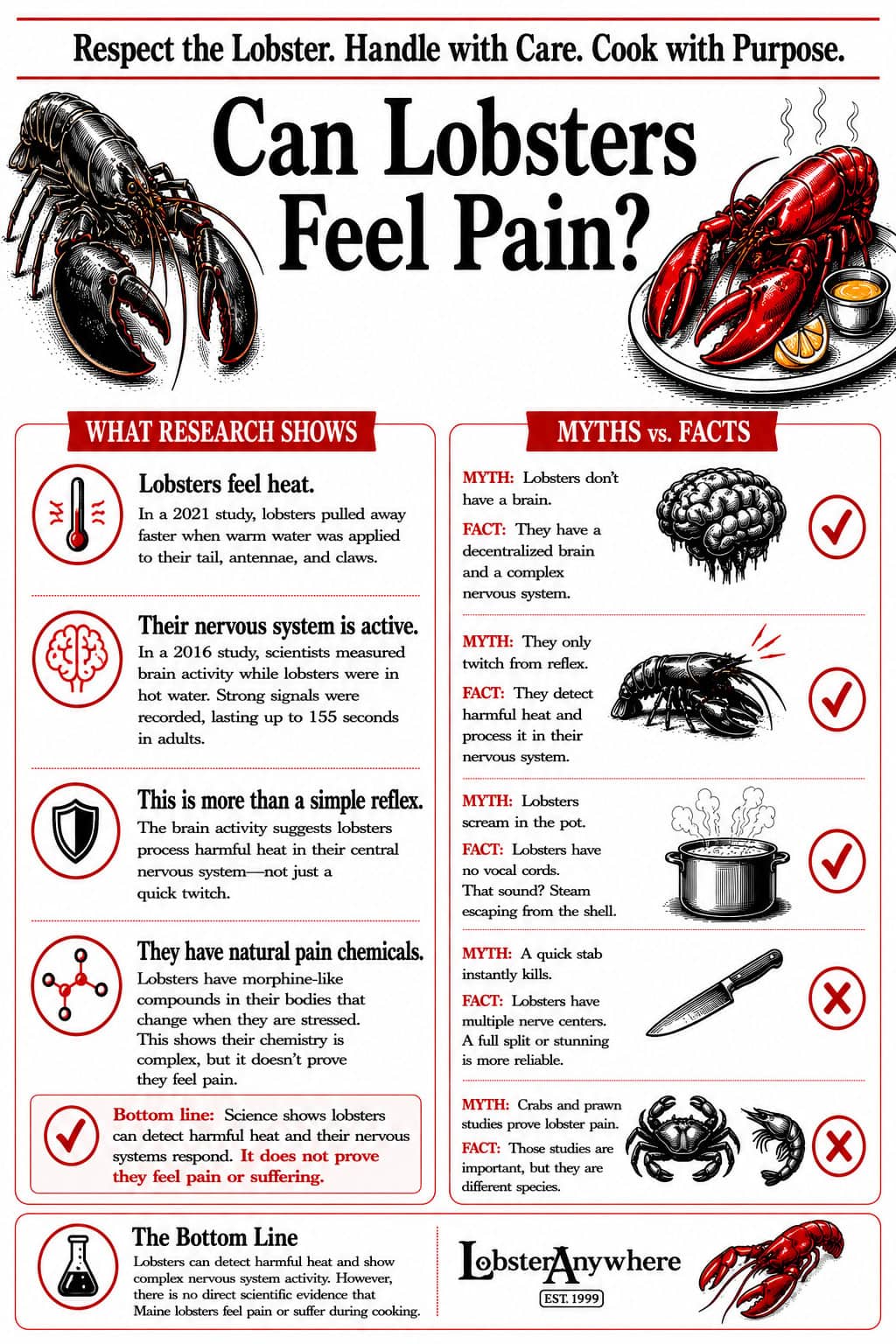
| “They detect harmful heat.” | Yes. Direct evidence supports thermal nociception. |
| “Chilling knocks a lobster out.” | Not proven, but cooling can reduce movement even though nerve responses stay detectable. |
| “Other crustaceans show pain-like behavior.” | Yes, and more clearly. The best evidence comes from crabs, prawns, crayfish, and Norway lobsters. |
| “So a lobster is just a reflex machine.” | Lobsters are not reflex machines, it is the difference in their nervous systems and behavior that are more complex than reflexes but potentially not as complex as ours which means they may not feel pain. |
Sources:
- 2021 UC San Diego (Gutierrez et al.): Produced the first behavioral evidence of thermal nociception in Maine lobster, almost as a side finding in a cannabis study. Dip a lobster’s tail or claws in warm water, and it withdraws; the warmer the water, the stronger the response. Honest caveat: small sample, and the cannabis itself barely moved the heat response.
- 2016 Electrophysiology Study (Fregin & Bickmeyer)): Implanted electrodes in lobster and crayfish nervous systems under different handling methods. Key findings: chilling did not shut down nerve responses, so it should not be described as true anesthesia. A sudden plunge into boiling water produced central nervous system activity that kept firing for roughly 155 seconds in adult American lobsters, with shorter activity recorded in smaller juvenile lobsters used in the same study. Caveat: some of the signal may be a heat artifact from recently dead tissue.
- 2005 Morphine Study (Casares et al.) ): Found morphine-like compounds in lobster tissue with levels climbing after stress. Not a behavioral test of pain, and the research line remains debated. One piece of the puzzle, not the answer.
Don’t Mix Up the Studies With Crabs and Shrimp
Most of what circulates online as proof of “lobster pain” actually comes from other decapods like crabs and shrimp, not the American lobster. Decapods are an order of crustaceans that includes lobsters, crabs, shrimp, crayfish, and prawns. These animals share a broadly similar decentralized, ganglia-based nervous system, which is why research on one species is relevant to the others, even when it is not a direct match.
These studies showed the following for specific species in the order, but may not apply to the Maine lobster you’re having for dinner.
- Shore crabs learned to avoid shelters paired with an electric shock, which fits the qualification for associative learning.
- Prawns repeatedly rubbed a chemically irritated antenna until a local anesthetic was applied and the rubbing stopped making it hard to say it was only a reflex.
- Norway lobsters, 2026 (Kasiouras et al.) had aspirin and lidocaine added to a shock tank which reduced rapid tail-flip responses. The study supports the idea that the response was mediated by nociception and adds to the case for higher-welfare handling, but it was not a study on American Maine lobsters.
- LSE Review, 2021 (Birch et al.) weighed more than 300 studies against eight criteria for sentience and found strong evidence in true crabs and substantial evidence in clawed lobsters and crayfish about pain. They then recommended all decapod crustaceans be treated as sentient under UK animal-welfare policy.
The species differ, but the pattern is consistent. Decapods look more complex, in both wiring and behavior, than anyone used to assume, but it does not mean that the Lobster you’re about to eat will feel pain.
Are Maine Lobsters an Exception?
There is a common notion that Maine lobsters have somehow been left out of all this research. This is half true. Much of the best-known work runs on shore crabs, hermit crabs, crayfish, prawns, European lobsters, or Norway lobsters. But the American lobster is a decapod crustacean, closely related to other clawed lobsters and crayfish, and it shares the nervous system architecture that researchers are studying. So it is more of an assumption that the Maine lobster would have the same response as their fellow decapods.
Fun fact: Lobsters have no vocal cords, so they cannot scream. The hiss you sometimes hear over a hot pot is usually steam or trapped air escaping the shell as the lobster heats up.
Where the Law Stands
The laws on cooking lobster varies by country, and it is drifting in a precautionary direction, especially outside North America.
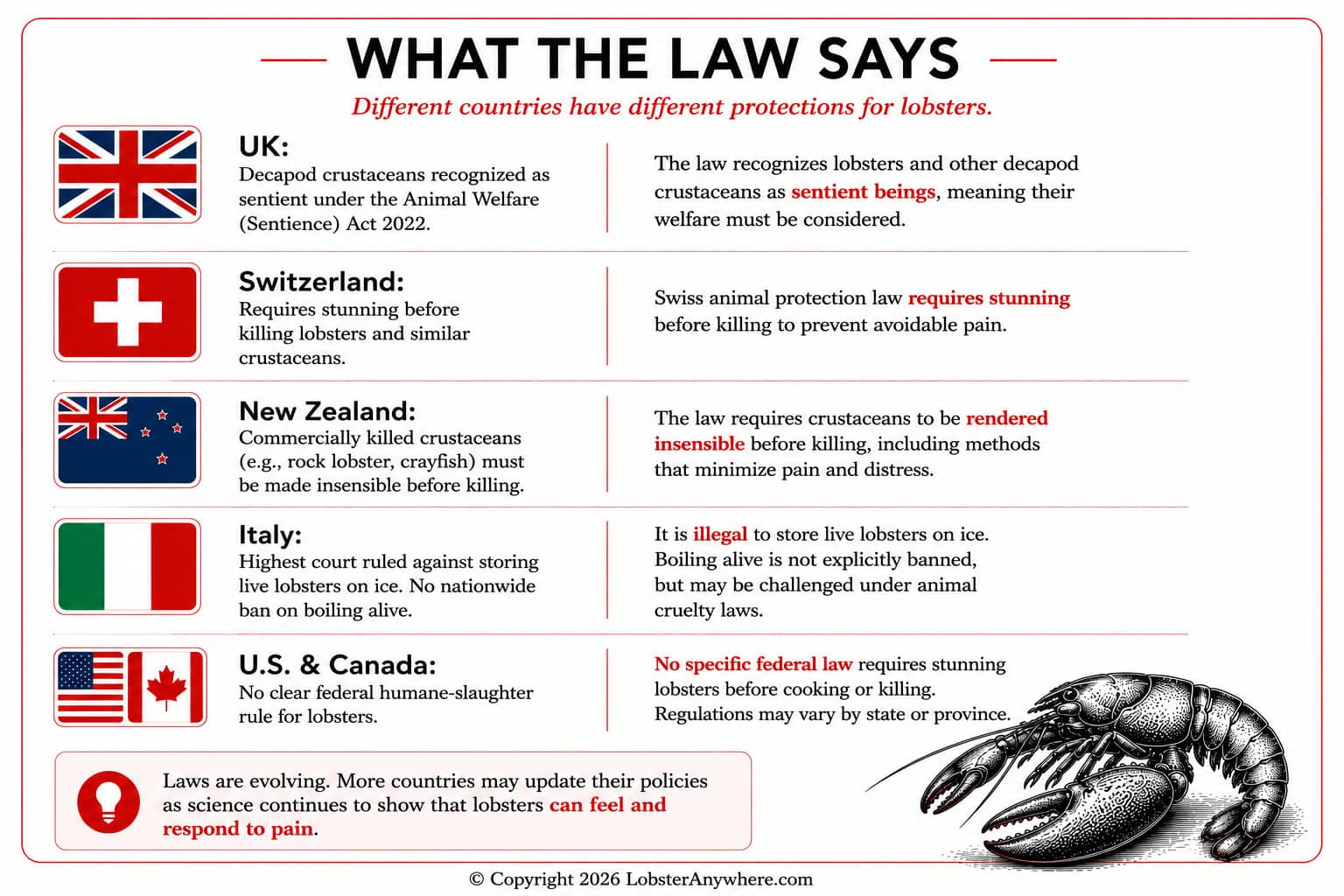
The United Kingdom recognized decapod crustaceans as sentient under the Animal Welfare (Sentience) Act 2022. In England, the government’s Animal Welfare Strategy, published in December 2025, said it will issue guidance clarifying that live boiling is not an acceptable killing method. That guidance is still separate from the older UK-wide sentience law. Switzerland requires that lobsters and similar crustaceans be stunned before they are killed. New Zealand requires certain commercially killed crustaceans, including rock lobster and crayfish, to be made insensible first. Italy’s highest court has ruled against keeping live lobsters stored on ice, though Italy has not banned boiling them alive nationwide.
The United States and Canada have no federal humane-killing rule for lobsters like the ones that cover livestock. For a home cook, the lesson holds no matter where the law sits, handle the lobster with care.
What This Means If You Cook Lobster at Home
You do not need to turn the kitchen into a lab, and you do not need to feel guilty for cooking lobster or invest in expensive shocking equipment. Just do your best to cut down on the lobster’s stress and avoid careless handling.
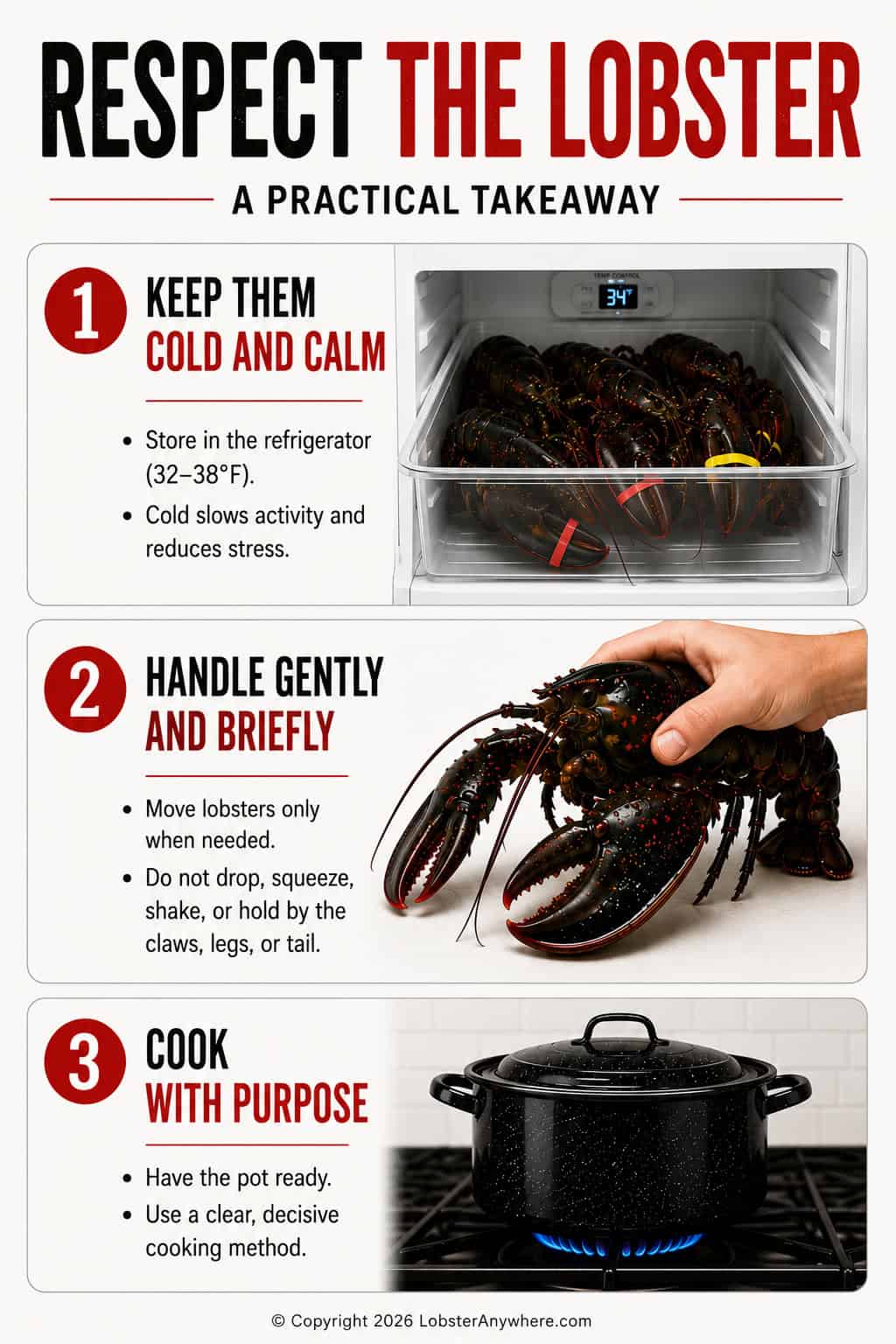
Keep live lobsters cold and moist until they go into the pot, and cook or drop them in promptly. A short chill makes a lobster easier and safer to handle, but as research shows, chilling is not a proven substitute for anesthesia and should not stand in for a humane kill. In commercial settings, electrical stunning is increasingly floated as a higher-welfare option, though it is not practical for most home kitchens.
For the step-by-step, see our guides on how to kill a lobster humanely, how to boil lobster, and how to store live lobster before you start.
Our View
We have shipped live Maine lobster since 1999, so this question is not abstract for us.
A lobster is food. It is also a living animal right up to the moment it is cooked or dispatched. Both things are true at once. We do not think home cooks should carry guilt to the stove, and we do think a live lobster deserves to be handled with respect. Keep it cold. Keep it moist. Do not leave it stressed in a warm kitchen. Cook or dispatch it quickly and cleanly. That is good seafood handling, and it is the right way to treat lobster on your counter.
Sources & Further Reading
The following sources informed the science and legal context in this article.
Gutierrez, A. et al. “Vapor Exposure to Δ9-Tetrahydrocannabinol (THC) Slows Locomotion of the Maine Lobster (Homarus americanus).” Pharmacology Biochemistry and Behavior, 2021. DOI: 10.1016/j.pbb.2021.173222. First behavioral evidence of thermal nociception in the American lobster, reported as a secondary finding in a cannabis study with a small sample.
Fregin, T. & Bickmeyer, U. “Electrophysiological Investigation of Different Methods of Anesthesia in Lobster and Crayfish.” PLOS ONE, 2016. DOI: 10.1371/journal.pone.0162894. Found that cooling does not abolish central nervous system responses and that slow warming ceases CNS activity above roughly 30 degrees C.
Casares, E. et al. “The American Lobster, Homarus americanus, Contains Morphine That Is Coupled to Nitric Oxide Release in Its Nervous and Immune Tissues.” Neuro Endocrinology Letters, 2005. PMID: 15855878. Stress-responsive endogenous morphine; a debated research line, cited here for neurochemical context only.
Kasiouras, E., Rotllant, G., Gräns, A. et al. “Effects of Analgesia on the Response to a Noxious Stimulus in Norway Lobsters (Nephrops norvegicus).” Scientific Reports, 2026. DOI: 10.1038/s41598-026-41687-w. Aspirin and lidocaine reduced shock-induced escape responses.
Birch, J. et al. “Review of the Evidence of Sentience in Cephalopod Molluscs and Decapod Crustaceans.” London School of Economics, 2021. Reviewed more than 300 studies and informed the UK’s Animal Welfare (Sentience) Act 2022.
Crump, A. et al. “Sentience in Decapod Crustaceans: A General Framework and Review of the Evidence.” Animal Sentience, 2022. Peer-reviewed framework for evaluating pain and sentience across decapod species.
Animal Welfare (Sentience) Act 2022. United Kingdom Parliament. Recognizes decapod crustaceans and cephalopod molluscs as sentient beings under UK law.
New Zealand Animal Welfare Regulations. Requires certain commercially killed crustaceans, including rock lobster and crayfish, to be made insensible before killing.
Weintraub, Karen. “The Swiss Consider the Lobster. It Feels Pain, They Decide.” The New York Times, January 12, 2018. Covers Switzerland’s lobster welfare rule and includes Joseph Ayers’ skeptical view that lobsters lack the neural hardware to feel pain.
University of Maine Lobster Institute. Anatomy, biology, and educational resources on the American lobster.