
When most people picture lobster, they see the whole package: bright red shell, two big claws, a pile of sweet meat, and a ramekin of melted butter. That’s Maine lobster (also called American lobster), and for good reason, it’s the gold standard.
But “lobster” covers a lot more ground than most shoppers realize. Some lobsters have claws. Others don’t. Some are sold almost exclusively as tails. And a few (looking at you, langostino) aren’t really lobsters in the traditional sense at all.
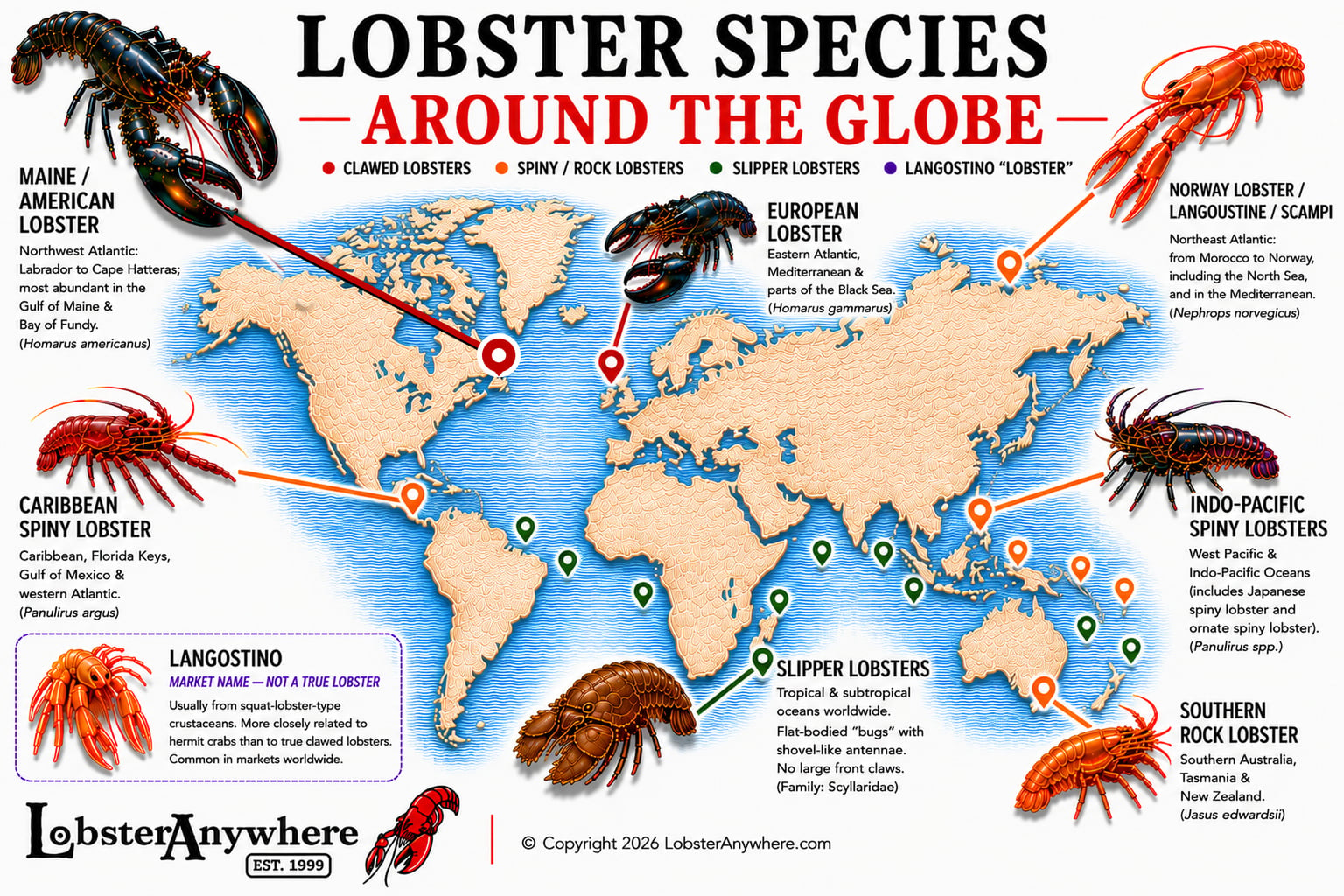
There are an estimated 149 marine lobster species worldwide, with some reports going over 200+ depending on how they define a lobster, spanning 10 families and 33 genera, though only a handful ever make it to your seafood market. For anyone buying or cooking lobster, the simplest way to make sense of it all is by group:
- Clawed lobsters – including Maine lobster and European lobster
- Spiny (rock) lobsters – often sold as lobster tails
- Slipper lobsters – flat-bodied with shovel-shaped antennae
- Lobster impostors – including langostino and squat lobster (more on the controversy behind that name below)
Maine lobster falls in the clawed group including cold-water, sweet-meat, and prized for three distinct cuts of meat: tail, claws, and knuckles.
The Main Types of Lobsters
While there are potentially hundreds of marine lobster, the three groups at the seafood counter, in restaurants, or that you can order online include:
- Clawed lobsters
- Spiny rock lobsters
- Slipper lobsters
Each have a different flavor profile and texture, so knowing the difference can save you from a disappointing dinner.
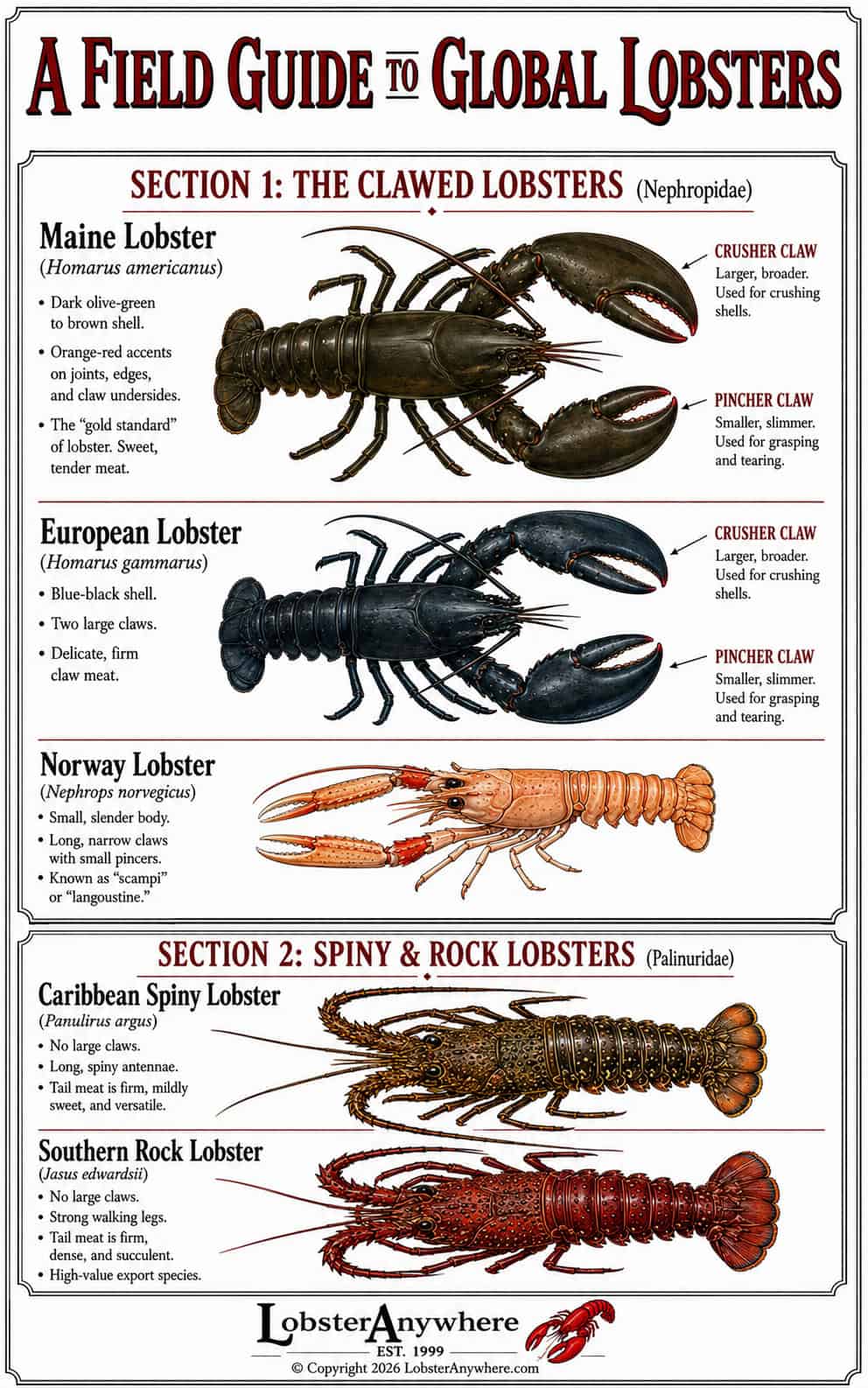
Maine lobster (Homarus americanus) is a clawed lobster native to the Northwest Atlantic, from Labrador down to Cape Hatteras, with the heaviest populations between Maine and New Jersey. They have two large front claws, sweet meat in the tail, claws, and knuckles.
Spiny and rock lobsters, by contrast, have no large front claws. They’re harvested almost entirely for tail meat creating a fundamentally different eating experience without the claw crackers or tender and sweet claw and knuckle meat.
| Group | Claws? | Main Meat | Common Names |
|---|---|---|---|
| Maine / American lobster | Yes | Tail, claws, knuckles | Maine, American, Canadian |
| Spiny/rock lobster | No large front claws | Tail | Rock, spiny, Florida, Caribbean |
| Slipper lobster | No large front claws | Tail | Slipper, bug, Moreton Bay bug |
| Langostino / squat lobster | No | Small tail-like meat | Langostino, langostino lobster, squat lobster |
1. Maine Lobster / American Lobster
Scientific name: Homarus americanus
Group: Clawed lobster
Region: Northwest Atlantic
Best known for: Sweet tail, claw, and knuckle meat
This is the lobster behind the classic New England dinner, where it gets steamed, cracked at the table, and dipped in drawn butter. You’ll also see it called American lobster, Atlantic lobster, northern lobster, or Canadian lobster, but they’re all the same species: Homarus americanus.
What sets Maine lobster apart from other lobsters, like Spiny, is the combination of a cold-water habitat and large claws. Unlike any rock or spiny lobster, you get three prized eating parts: the tail, the claws, and the knuckles.
For a broader look at Maine lobster history, grades, seasons, shell types, colors, cooking, and terminology, see our Lobster 101 guide.
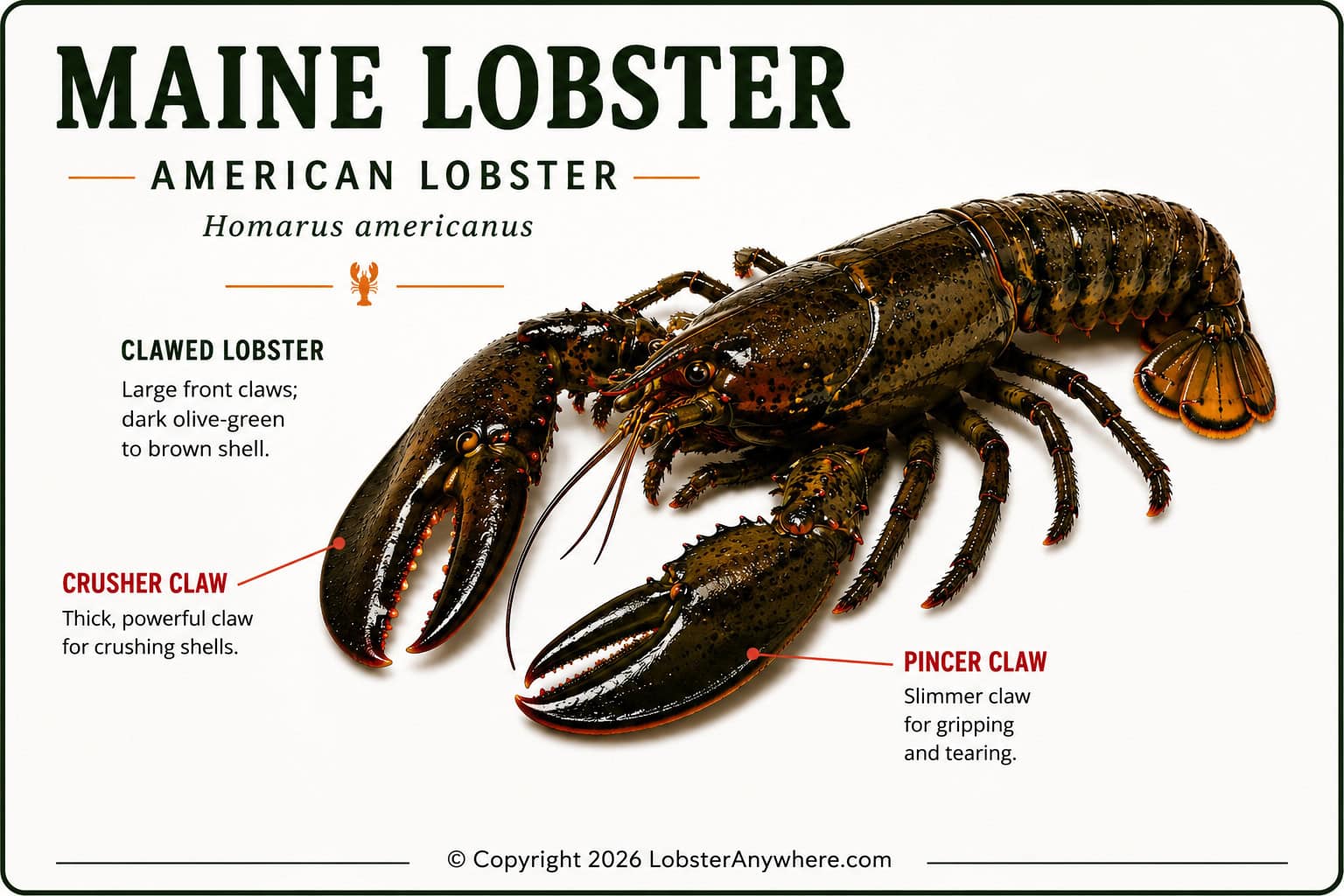
How to Identify a Maine Lobster
The quickest way to identify a Maine lobster is to count the claws as a whole Maine lobster has two large front claws, one crusher (thick, for breaking shells) and one pincer or cutter (thinner, for tearing). No large front claws? Not a Maine lobster.
| Feature | Maine Lobster |
| Claws | Two large front claws (crusher + pincer) |
| Main edible meat | Tail, claws, and knuckles |
| Raw shell color | Mottled greenish-brown or dark blue-green |
| Cooked shell color | Bright red |
| Flavor | Sweet, clean, cold-water flavor |
| Texture | Tender claws and knuckles; firmer tail |
Click here for our complete guide to lobster anatomy.
2. European Lobster
Scientific name: Homarus gammarus
Group: Clawed lobster
Region: Eastern Atlantic and Mediterranean
Best known for: Close relative of the Maine lobster
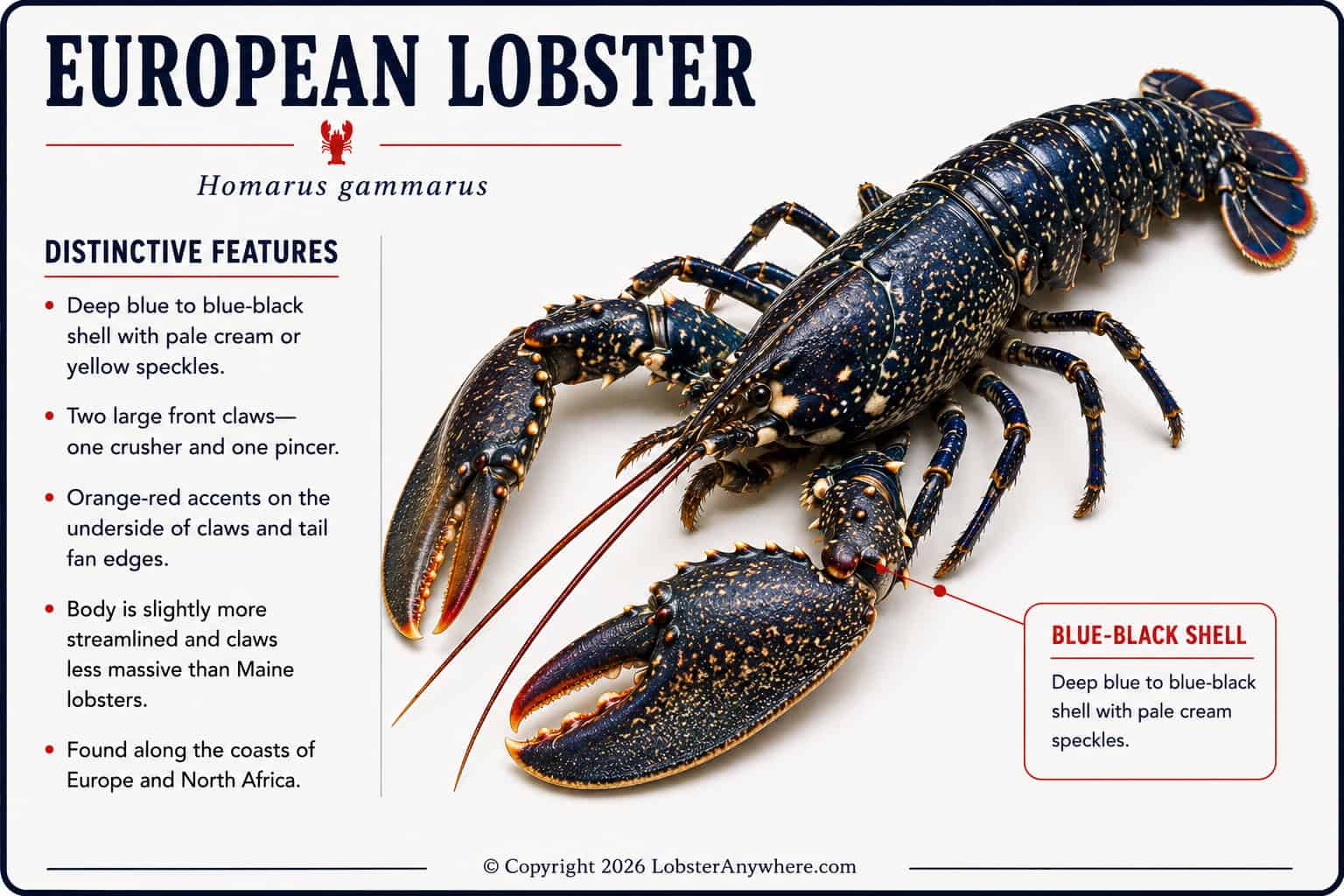
The European lobster is the closest Old World cousin of the Maine lobster. Similar to Maine lobsters, the European lobster has two big claws in front, meat in the tail, and its claws turn red when cooked. In the wild, they’re a striking dark blue or blue-black where the Maine lobsters are an olive-green to greenish-brown.
Just like the American lobster, European lobsters and not cheap and U.S. shoppers rarely encounter it. If you want a clawed, cold-water lobster on this side of the Atlantic, Maine lobster is the better choice as you won’t have to incur shipping or import costs since Maine is fished fresh here.
3. Norway Lobster / Langoustine / Scampi
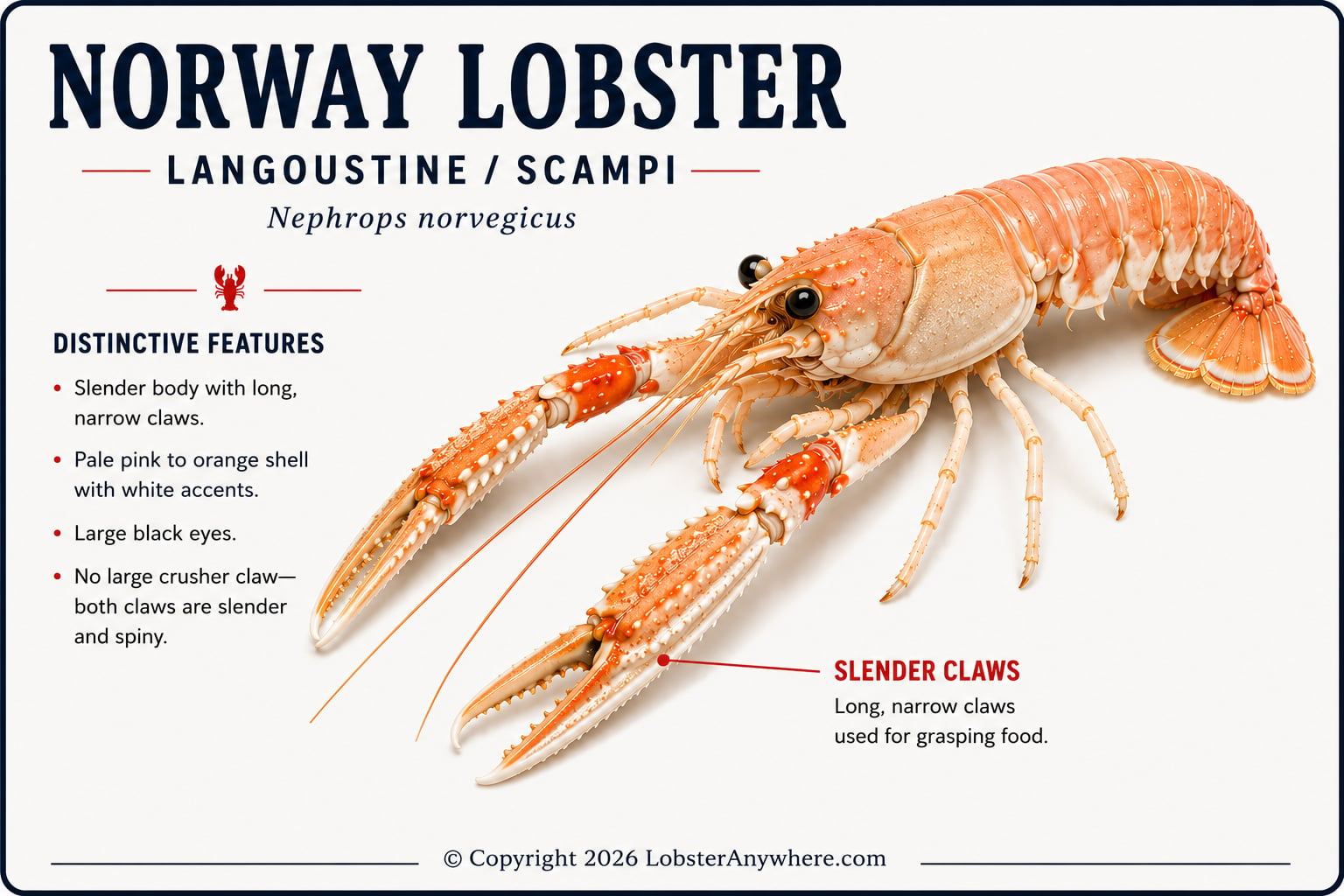
Scientific name: Nephrops norvegicus
Group: Clawed lobster
Region: Northeast Atlantic
Best known for: Scampi and langoustine dishes
Norway lobster is much smaller and slimmer than Maine lobster. Yes, it has claws, but you won’t get the same big claw-and-knuckle eating experience. Think of it more as a delicate, European-style shellfish.
The naming gets tricky for American shoppers. In Europe, Norway lobster is called langoustine. In the U.S., “scampi” usually means a garlic-butter shrimp preparation and not the actual animal. Langoustines are legitimate clawed lobsters, just not the same animal as Maine lobster.
4. Spiny Lobsters / Rock Lobsters
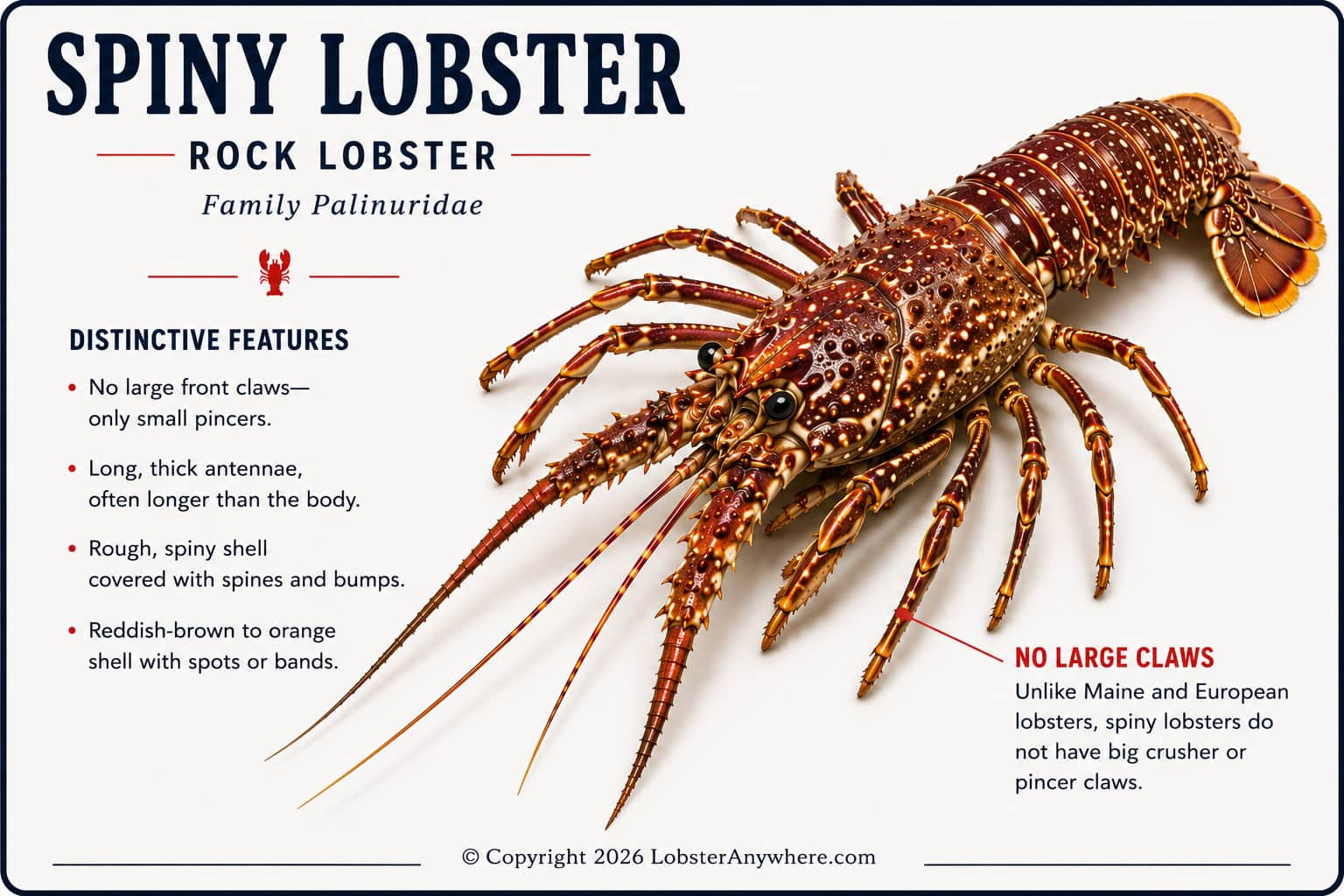
Group: Spiny/rock lobster
Family: Palinuridae
Region: Tropical and subtropical oceans worldwide
Best known for: Clawless lobster tails
This is where most shoppers get tripped up. Spiny lobsters (also called rock lobsters) have no large front claws. Some of their signature features include long antennae, spiny shells, and almost all the meat is concentrated in the tail.
The shopper-friendly takeaway: Maine lobster gives you tail, claw, and knuckle meat. Rock lobster is a tail-only proposition.
Spiny lobsters live in warmer and temperate waters worldwide, including the Caribbean, Florida, California, Australia, New Zealand, Japan, and parts of the Mediterranean. They’re the source of most of the frozen lobster tails you see in grocery store freezer cases.
For a detailed side-by-side, see our guide to rock lobster vs. Maine lobster.
5. Caribbean Spiny Lobster
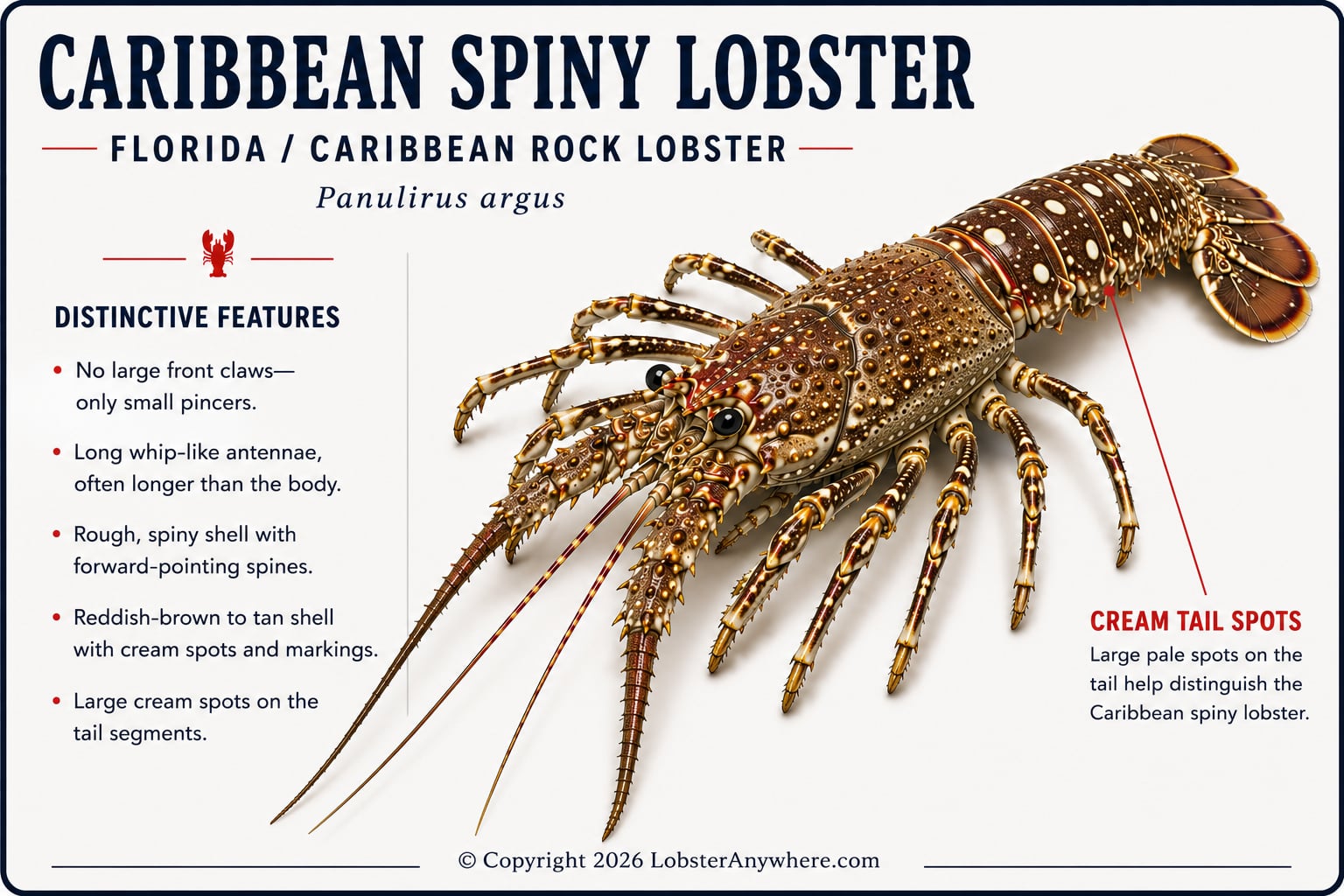
Scientific name: Panulirus argus
Group: Spiny/rock lobster
Region: Caribbean, Florida, Gulf of Mexico, western Atlantic
Best known for: Warm-water lobster tails
This is one of the most common warm-water lobster species in the U.S. market. You’ll see it labeled as Florida lobster, rock lobster, crawfish, or langosta, depending on who’s selling it.
Unlike Maine lobsters, the Caribbean lobster has no claws and is harvested for the tail. Caribbean spiny lobster tails hold up well on the grill, but the meat is firmer than Maine lobster, and you won’t find any claw or knuckle meat in the package.
6. Australian Rock Lobsters
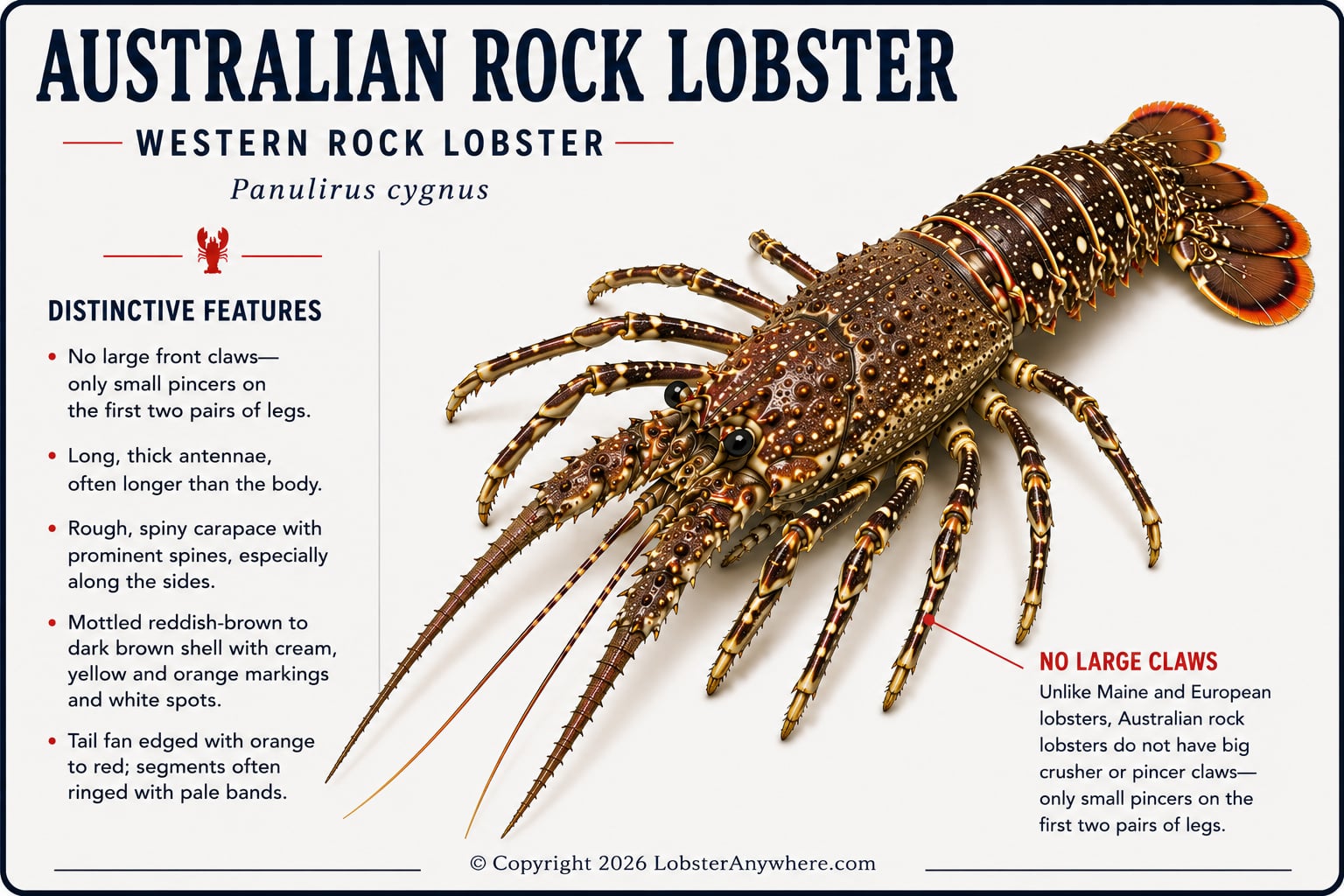
Examples: Western rock lobster, southern rock lobster
Group: Spiny/rock lobster
Region: Australia and New Zealand
Best known for: High-value export lobster
Australia produces several commercially important rock lobster species, and they command serious prices in international markets, especially in Asia. These are sold as premium lobster tails or whole cooked rock lobsters.
While they are good eating, they come with hefty prices to match. But they’re clawless, so the experience is all about the tail.
7. Japanese and Ornate Spiny Lobsters
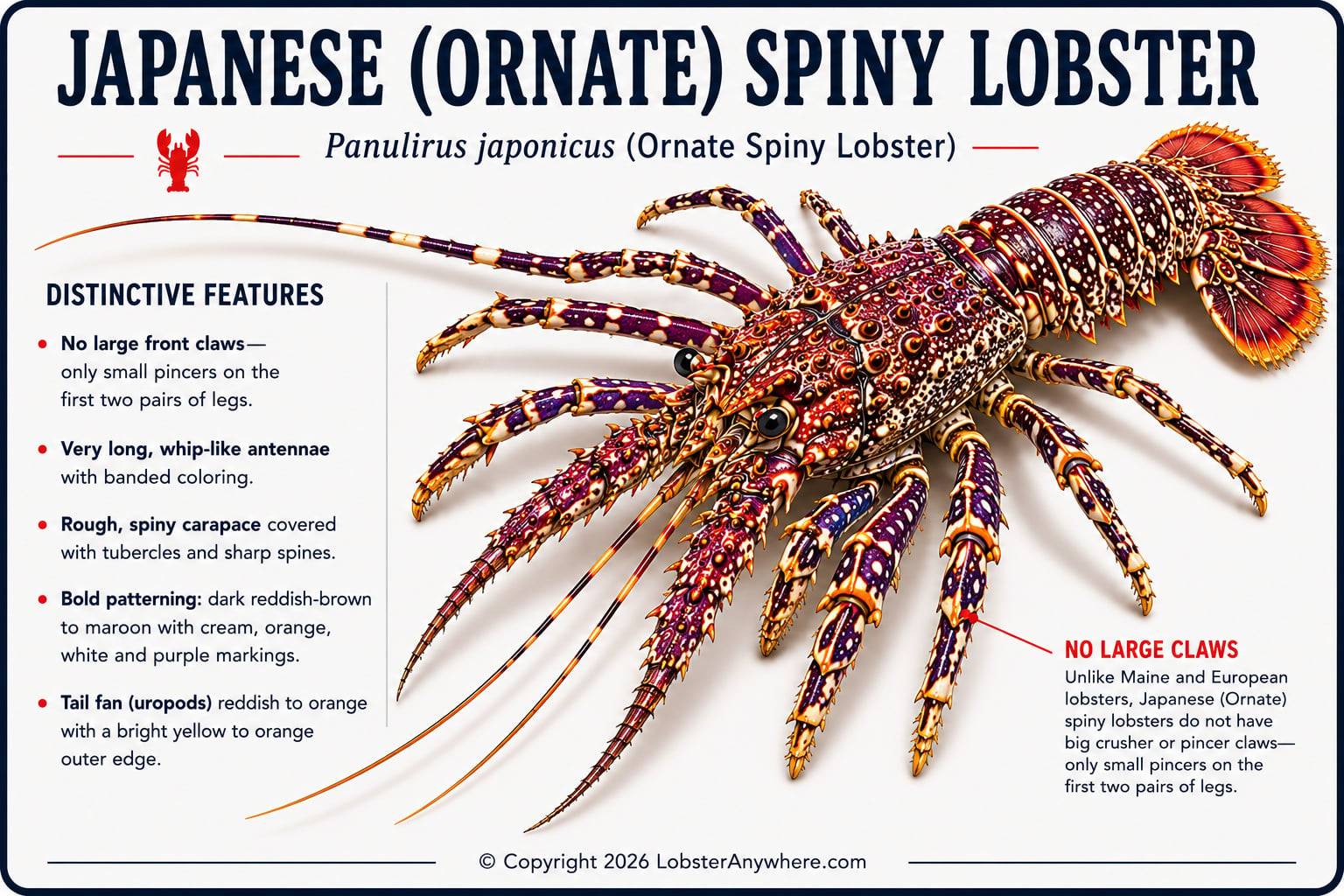
Examples: Japanese spiny lobster, ornate spiny lobster
Group: Spiny/rock lobster
Region: Japan, East Asia, Indo-Pacific
Best known for: Large, high-value regional seafood
Big, colorful animals with long, banded antennae and firm tail meat. In some Asian markets, live specimens can fetch extraordinary prices. Still no claws, though, so for the American shopper it’s the same story, tail meat only.
8. Slipper Lobsters
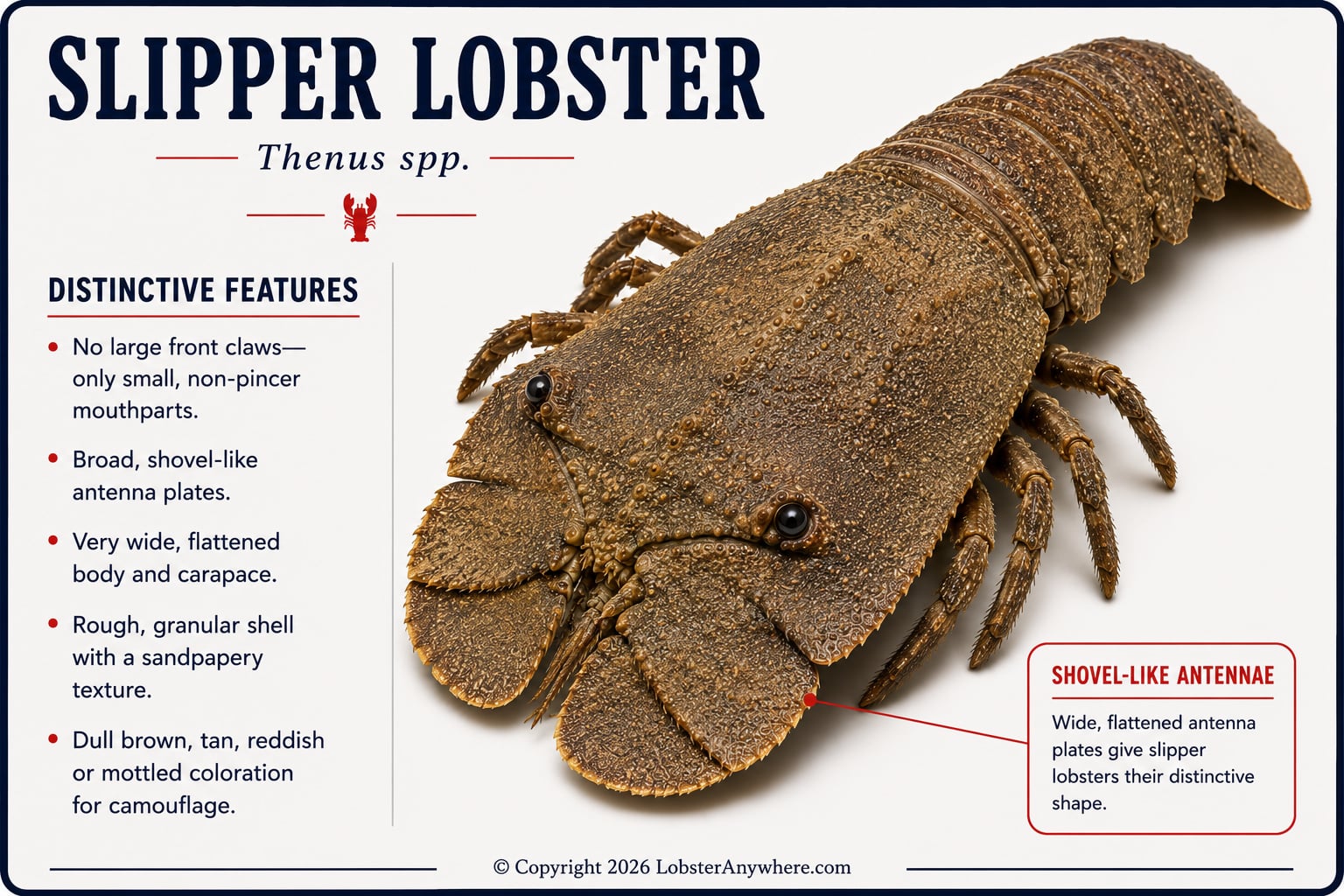
Group: Slipper lobster
Family: Scyllaridae
Region: Tropical and subtropical oceans worldwide
Best known for: Flattened body and shovel-like antennae
Slipper lobsters are true lobsters, but they look nothing like the Maine lobster on your dinner plate. No large claws, no long whip-like antennae. Instead, they’re flat-bodied with broad, shovel-shaped antennae that give them a prehistoric look.
Some are sold regionally under colorful names like “Moreton Bay bugs” in Australia. They are edible and commercially harvested in certain regions like Asia and southeastern Brazil, but largely unfamiliar to U.S. shoppers.
Langostino and Squat Lobster – The Lobster Impostors
Langostino may look like lobster meat, but don’t be fooled, it isn’t Maine lobster. It comes from a squat lobster-type crustacean, a small creature that’s actually more closely related to hermit crabs than to the true clawed lobsters we pull from the cold waters of Maine.
The FDA allows certain squat lobster species to be sold under the market name “langostino lobster.” But calling it just “lobster” without that qualifier has a long legal trail. Rubio’s was sued over its “lobster burrito” in 2005 (it was langostino). The FTC investigated Long John Silver’s for airing a TV ad showing American lobster while selling langostino “Lobster Bites.” Maine’s Senator Olympia Snowe called langostino an “impostor” on the record, and the Maine Lobster Promotion Council estimated $44 million in lost sales to restaurant chains that made the switch.
Langostino meat works fine in pasta, dips, seafood salads, and budget-friendly dishes. Just know what you’re buying, and don’t pay Maine lobster prices for it.
For the full labeling history and a detailed comparison, see our guide to langostino vs. Maine lobster.
Maine Lobster vs. Other Lobsters: The Big Difference
It comes down to clawed vs. clawless.
| Type | Large claws? | Main edible meat | Common use |
|---|---|---|---|
| Maine lobster | Yes | Tail, claws, knuckles | Whole lobster, lobster rolls, picked lobster meat, lobster dinners |
| European lobster | Yes | Tail, claws, knuckles | European seafood dishes |
| Norway lobster / Langoustine | Yes, but small and slender | Tail and small claw meat | Scampi, langoustine dishes |
| Spiny / rock lobster | No large front claws | Tail | Grilled tails, frozen lobster tails |
| Slipper lobster | No large front claws | Tail | Regional seafood dishes |
| Langostino / squat lobster | No | Small tail-like meat | Pastas, dips, seafood salads, seafood blends |
Maine lobster isn’t just “a lobster tail.” It’s a whole cold-water animal with sweet meat in three distinct parts: claws, knuckles, and tail. Which is exactly why it’s the backbone of lobster rolls, steamed lobster dinners, lobster mac and cheese, and premium-picked lobster meat.
Don’t Confuse These Names with Maine Lobster
Seafood labeling can be equally as confusing as marketers will have some fun with the naming. Here’s some examples of what you may assume is “Main lobster” on packaging, and what it really is.
| Name on menu or package | Maine lobster? | What it usually means |
|---|---|---|
| Maine lobster | Yes | Homarus americanus |
| American lobster | Yes | Homarus americanus, the same as the Maine lobster |
| Canadian lobster | Same species | Homarus americanus caught in Canadian waters |
| North Atlantic lobster | Usually | Often used for Homarus americanus |
| Rock lobster | No | Usually spiny lobster; clawless and mostly tail meat |
| Spiny lobster | No | Clawless lobster, mostly tail meat |
| Slipper lobster | No | Flattened, clawless lobster with broad antennae |
| Langoustine | No | Often spiny or rock lobster, unless labeled Maine, American, or cold-water lobster |
| Langostino | No | Usually squat lobster or pelagic crab; may be sold as “langostino lobster,” but it is not Maine lobster |
| Lobster tail | Maybe | Often spiny or rock lobster unless labeled Maine, American, or cold-water lobster |
Best Lobster for Flavor
When buying lobster online or at a seafood counter, check the label. Does it say Maine lobster, American lobster, rock lobster, spiny lobster, or just “lobster tail”? If you want sweet claw, knuckle, and tail meat (the full lobster experience), look for Homarus americanus. Maine lobster. It’s the only one that gives you all three.
Flavor depends on species, handling, freshness, and how you cook it. But for that classic sweet lobster flavor, Maine lobster is the benchmark, and it isn’t a close call.
You get sweet claw meat, tender knuckle meat (the sleeper hit), a firm, meaty tail, a clean, cold-water flavor that doesn’t need much embellishment, and the versatility to steam, boil, grill, stuff into a roll, or pick for lobster-meat dishes.
Spiny and rock lobsters can be delicious, especially grilled, but they’re firmer and all about the tail. Slipper lobsters and langostino have their place in the seafood world, but they’re a different experience entirely.
There are hundreds of marine lobster species around the world, but only one Homarus americanus.
Spiny, rock, slipper, European, Norwegian, Japanese, Caribbean, and Australian all have a place in global seafood. Some are prized for tail meat, some are regional delicacies, and others are marketed in ways that leave shoppers scratching their heads.
If you want the lobster behind the classic New England seafood dinner, the lobster bake, the Maine lobster roll, the experience of cracking into a whole lobster at the table, you want Maine lobster. Cold water. Clawed. Sweet tail, claw, and knuckle meat. That’s the one.