
Are you looking for an easy-to-make gluten- and alcohol-free lobster bisque that is lux, rich, and gives you that oceanic flavor your taste buds crave? This recipe is for you. Custom-created for LobsterAnywhere by gluten-free recipe creator Leslie Chitoff of Culibloom, you’ll enjoy the relaxing, simple 11-step process, from sautéing veggies to building the soup base and, of course, adding the garnishes for pops of color and style.

While the classic French recipe requires white wine or brandy, we’ve modified it so you can use alcohol or skip it, depending on your preference. The white wine and brandy add depth to classic bisque; chicken broth combined with fresh lemon juice is a perfect alternative for providing the acidity and complexity needed to balance the rich butter and cream without using alcoholic beverages.
Serve this homemade lobster bisque as an impressive appetizer for Christmas, Valentine’s Day, anniversaries, dinner parties, or other celebrations. It can also become a satisfying main course when paired with gluten-free artisan bread, certified gluten-free crackers, or a fresh garden salad.
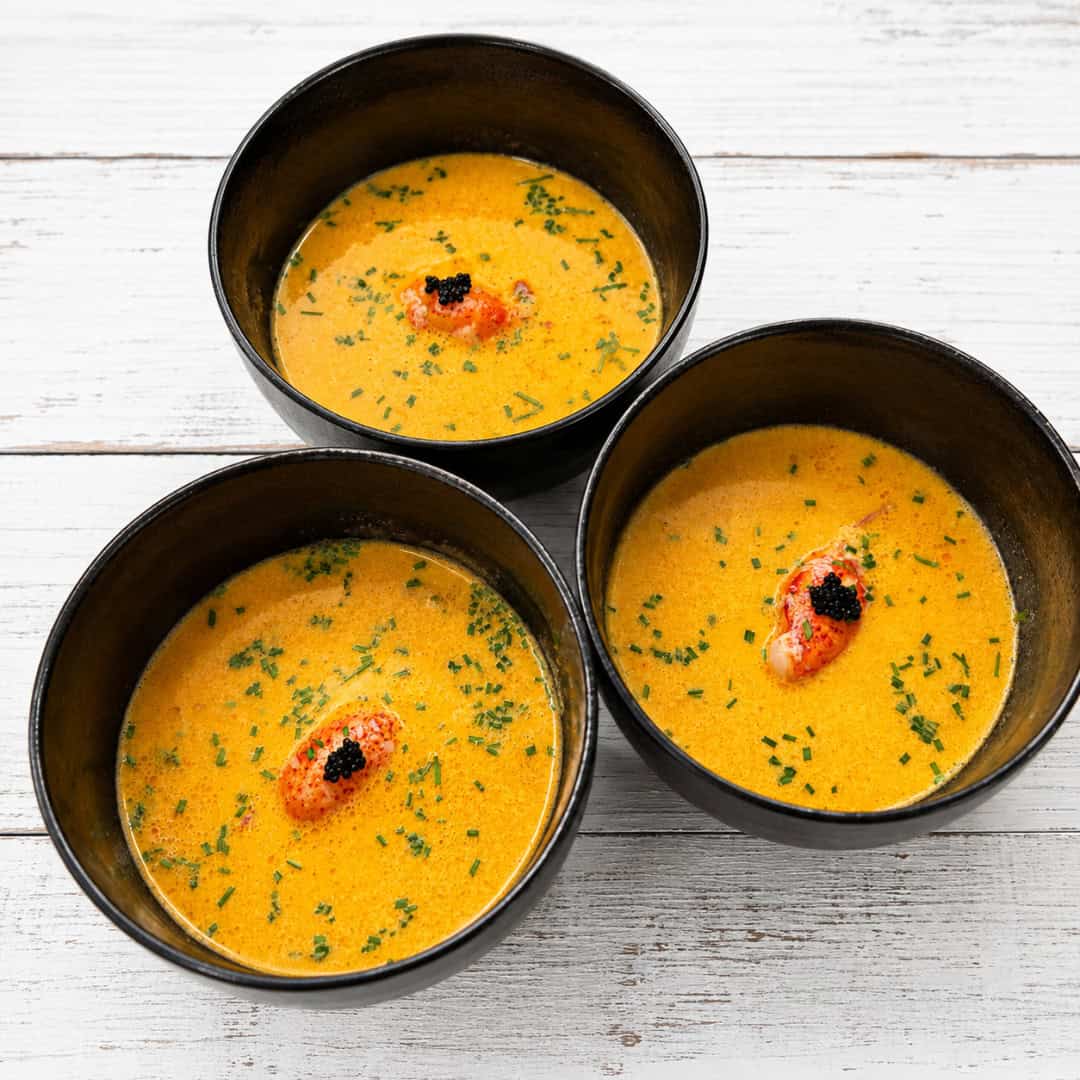
Gluten-free Lobster Bisque
Ingredients
Equipment
Method
- Chop the onion, celery, and carrots into evenly sized pieces so they cook at the same rate. Mince the garlic and cut the cooked lobster meat into bite-sized pieces. Reserve several attractive pieces of lobster for garnishing the finished bowls.
- Melt the butter with the olive oil in a large, heavy-bottomed soup pot over medium heat. Add the onion, celery, and carrots. Cook for 8 to 10 minutes, stirring occasionally, until the vegetables are tender and fragrant but not browned.Add the garlic and cook for 1 minute, stirring constantly to prevent it from burning.
- Add the tomato paste to the vegetables. Cook for approximately 2 minutes, stirring frequently, until the tomato paste darkens slightly and coats the vegetables.Cooking the tomato paste develops its flavor and removes its raw, acidic taste.
- Remove the pot from the heat before carefully adding the brandy. Return the pot to medium heat and cook for 1 to 2 minutes, scraping the bottom with a wooden spoon to release any flavorful browned bits.Stir in the dry white wine and simmer for approximately 5 minutes, or until the liquid has reduced slightly.For the alcohol-free version, add ¼ cup chicken broth in place of the brandy. Scrape the bottom of the pot, then stir in 1 cup additional chicken broth, 1 tablespoon lemon juice, and the optional white wine vinegar. Simmer for approximately 5 minutes before continuing with the recipe.
- Pour 3 cups of certified gluten-free chicken broth into the pot. Add the bay leaf, parsley sprigs, tarragon sprigs, salt, cayenne pepper, and ground coriander.Bring the mixture to a gentle boil. Reduce the heat to low, partially cover the pot, and simmer for approximately 20 minutes, or until the vegetables are completely tender and the flavors have blended.
- Remove and discard the bay leaf, parsley sprigs, and tarragon sprigs. Add approximately one-quarter of the lobster meat to the soup. Blending a portion of the lobster into the base gives the bisque a deeper seafood flavor.
- Remove the pot from the heat. Use an immersion blender to purée the soup until it is completely smooth and creamy.If using a countertop blender, allow the soup to cool slightly and blend it in small batches. Never fill the blender more than halfway with hot liquid. Vent the lid carefully and cover the opening loosely with a clean kitchen towel so steam can escape.
- For an especially smooth and refined texture, pour the blended soup through a fine-mesh sieve. Press the mixture gently with the back of a spoon, then return the strained bisque to the pot.Straining is optional, but it creates the silky consistency traditionally associated with French lobster bisque.
- Place the pot over low heat and stir in the half-and-half. Add the remaining lobster meat, except for the pieces reserved for garnish.Warm the bisque gently for 8 to 10 minutes, stirring occasionally. Do not allow the soup to boil after adding the half-and-half. High heat can cause the dairy to separate and may make the lobster meat tough.
- Taste the bisque and add more salt, black or white pepper, cayenne pepper, or ground coriander as desired.If the bisque is thicker than you prefer, stir in a small amount of warm gluten-free chicken broth until it reaches your desired consistency.
- Ladle the hot lobster bisque into warmed bowls. Top each serving with the reserved lobster meat.Garnish with minced chives, fresh parsley, tarragon, microgreens, or a small spoonful of caviar, if desired. Serve immediately with warm gluten-free artisan bread or certified gluten-free crackers.
Notes
- Freshly cooked lobster delivers excellent flavor, but high-quality frozen lobster meat can also be used. Thaw frozen lobster completely and pat it dry before adding it to the bisque.
- Half-and-half creates a creamy bisque that is rich without being excessively heavy. For an even richer soup, replace it with an equal amount of heavy cream.
- The alcohol-free version has a slightly milder flavor but remains rich, balanced, and delicious. Lemon juice provides acidity, while optional white wine vinegar adds another layer of complexity.
- If using white wine vinegar, verify that the product is gluten-free when cooking for someone with celiac disease or gluten sensitivity.
- Do not add lemon juice directly to the half-and-half. It should be simmered with the broth before the dairy is added to reduce the chance of curdling.
- An immersion blender is the safest and easiest tool for puréeing the hot soup. If using a countertop blender, process the soup in small batches and allow steam to escape.
- Straining the bisque is optional. It takes a few additional minutes but produces a smoother, more elegant texture.
- Caviar is optional and can be omitted without affecting the bisque. For a more affordable garnish, use chopped chives, microgreens, or small pieces of lobster.
- Store leftover lobster bisque in an airtight container in the refrigerator for up to 2 days. Reheat it slowly over low heat, stirring frequently. Do not allow it to boil.
- Freezing is not recommended because the dairy may separate and develop a grainy texture after thawing.
Tried this recipe?
Let us know how it was!Prep Time: 20 minutes
Cook Time: 55 minutes
Total Time: 1 hour 15 minutes
Yield: 4 to 6 servings
Ingredients
Both the traditional and alcohol-free versions are going to wow your guests and tantalize your tastebuds, and here’s how the ingredients shift so you can create the one that is right for you.
For Traditional Gluten-free Lobster Bisque:
- 4 tablespoons unsalted butter
- 1 tablespoon extra-virgin olive oil
- 1 cup peeled and chopped yellow onion
- 1 cup chopped celery
- 1 cup peeled and chopped carrots
- 2 garlic cloves, minced
- 2 tablespoons tomato paste
- ¼ cup brandy
- 1 cup dry white wine
- 3 cups certified gluten-free low-sodium chicken broth
- 1 bay leaf
- 3 sprigs fresh flat-leaf parsley
- 2 sprigs fresh tarragon
- ½ teaspoon kosher salt, plus more to taste
- ¼ teaspoon cayenne pepper, or to taste
- ¼ teaspoon ground coriander
- ¾ pound cooked lobster meat, divided
- 1½ cups half-and-half
- Freshly ground white or black pepper, to taste
- Minced fresh chives for garnish, optional
- Fresh parsley or tarragon for garnish, optional
- Microgreens for garnish, optional
- ¼ cup caviar for garnish, optional
For the Alcohol-Free Option
- ¼ cup additional certified gluten-free chicken broth to replace the brandy
- 1 cup additional certified gluten-free chicken broth to replace the wine
- 1 tablespoon fresh lemon juice
Directions
Step 1: Prepare the Ingredients
Start by chopping the onion, celery, and carrots into evenly sized pieces so they cook at the same rate. Now mince the garlic and cut the cooked lobster meat into bite-sized pieces. If you have raw lobster meat, a quick boil or steam for around 7 or 8 minutes, until the temperature reaches between 130 and 140 degrees Fahrenheit. Make sure to save several attractive pieces of lobster for garnishing the finished bowls.
Pro-tip: Lobster claws can be a fun and immersive garnish on top of the bisque or off the side of the bowl. Our lobster claw and knuckle meat kit is perfect for this.
Step 2: Sauté the Vegetables
Now melt the butter with the olive oil in a large, heavy-bottomed soup pot over medium heat. The heavy bottom is important here as it helps prevent the ingredients like half-and-half from burning. Add the onion, celery, and carrots. Cook for 8 to 10 minutes, stirring occasionally, until the vegetables are tender and fragrant but not browned. Next, add the garlic and cook for 1 minute, stirring constantly with the slotted spoon or silicone spatula to prevent it from burning.
Step 3: Cook the Tomato Paste
At this point, you want to add the tomato paste to the vegetables and cook for approximately 2 minutes, stirring frequently, until the tomato paste darkens slightly and coats the vegetables. Cooking the tomato paste develops its flavor and removes its raw, acidic taste.
Step 4: Deglaze the Pot
For deglazing the pot, start by removing the pot from the heat before carefully adding the brandy. Once added, return the pot to medium heat and cook for 1 to 2 minutes, scraping the bottom with a wooden spoon or spatula to release any flavorful browned bits. Now stir in the dry white wine and simmer for approximately 5 minutes, or until the liquid has reduced slightly.
For the alcohol-free version, add ¼ cup chicken broth in place of the brandy. Scrape the bottom of the pot, then stir in 1 cup additional chicken broth, 1 tablespoon lemon juice, and the optional white wine vinegar. Simmer for approximately 5 minutes before continuing with the recipe.
Step 5: Build the Soup Base
To build the base, pour 3 cups of certified gluten-free chicken broth into the pot. Add the bay leaf, parsley sprigs, tarragon sprigs, salt, cayenne pepper, and ground coriander.
Bring the mixture to a gentle boil, then reduce the heat to low, partially cover the pot, and let it simmer for approximately 20 minutes, or until the vegetables are completely tender and the flavors have blended.
Step 6: Add Some of the Lobster
Remove and discard the bay leaf, parsley sprigs, and tarragon sprigs. Add approximately one-quarter of the lobster meat to the soup, blending a portion into the base to give the bisque a deeper seafood flavor.
Step 7: Blend the Bisque
Next, remove the pot from the heat and use an immersion blender to purée the soup until it is completely smooth and creamy.
If using a countertop blender, allow the soup to cool slightly and blend it in small batches. You never want to fill the blender more than halfway with hot liquid as it could splash. Hot liquids build up steam quickly, creating pressure that can cause the lid to pop off. Now vent the lid carefully and cover the opening loosely with a clean kitchen towel so steam can escape.
Step 8: Strain the Bisque
For an especially smooth and refined texture, pour the blended soup through a fine-mesh sieve. Once the liquid has passed through, press the mixture gently with the back of a spoon and return the strained bisque to the pot.
Straining is optional, but it creates the silky consistency traditionally associated with French lobster bisque.
Step 9: Add the Cream and Remaining Lobster
Place the pot over low heat and stir in the half-and-half. Add the remaining lobster meat, except for the pieces reserved for garnish. The goal here is to gently warm the bisque for 8 to 10 minutes, stirring occasionally.
Pro-tip: Do not allow the soup to boil after adding the half-and-half, as high heat can cause the dairy to separate and may make the lobster meat tough.
Step 10: Adjust the Seasonings
Taste the bisque and add more salt, black or white pepper, cayenne pepper, or ground coriander as desired. If the bisque is thicker than you prefer, stir in a small amount of warm gluten-free chicken broth until it reaches your desired consistency.
Step 11: Garnish and Serve
Ladle the hot lobster bisque into warmed bowls and top each serving with the reserved lobster meat.
Garnish with minced chives, fresh parsley, tarragon, microgreens, or a small spoonful of caviar, if desired. Serve immediately with warm gluten-free artisan bread or certified gluten-free crackers.
Prep Notes
- Always read ingredient labels carefully. Chicken broth, tomato paste, seasonings, caviar, and other packaged ingredients should be verified as gluten-free.
- Freshly cooked lobster delivers excellent flavor, but high-quality frozen lobster meat can also be used. Thaw frozen lobster completely and pat it dry before adding it to the bisque.
- Half-and-half creates a creamy bisque that is rich without being excessively heavy. For an even richer soup, replace it with an equal amount of heavy cream.
- The alcohol-free version has a slightly milder flavor but remains rich, balanced, and delicious. Lemon juice provides acidity, while optional white wine vinegar adds another layer of complexity.
- If using white wine vinegar, verify that the product is gluten-free when cooking for someone with celiac disease or gluten sensitivity.
- Do not add lemon juice directly to the half-and-half. It should be simmered with the broth before the dairy is added to reduce the chance of curdling.
- An immersion blender is the safest and easiest tool for puréeing the hot soup. If using a countertop blender, process the soup in small batches and allow steam to escape.
- Straining the bisque is optional. It takes a few additional minutes but produces a smoother, more elegant texture.
- Caviar is optional and can be omitted without affecting the bisque. For a more affordable garnish, use chopped chives, microgreens, or small pieces of lobster.
- Store leftover lobster bisque in an airtight container in the refrigerator for up to 2 days. Reheat it slowly over low heat, stirring frequently. Do not allow it to boil.
- Freezing is not recommended because the dairy may separate and develop a grainy texture after thawing.