
The seas is full of both fearful and beautiful things but none lovelier than the fluted shellfish, the scallop
J. George Frederick in Long Island Seafood Cookbook.
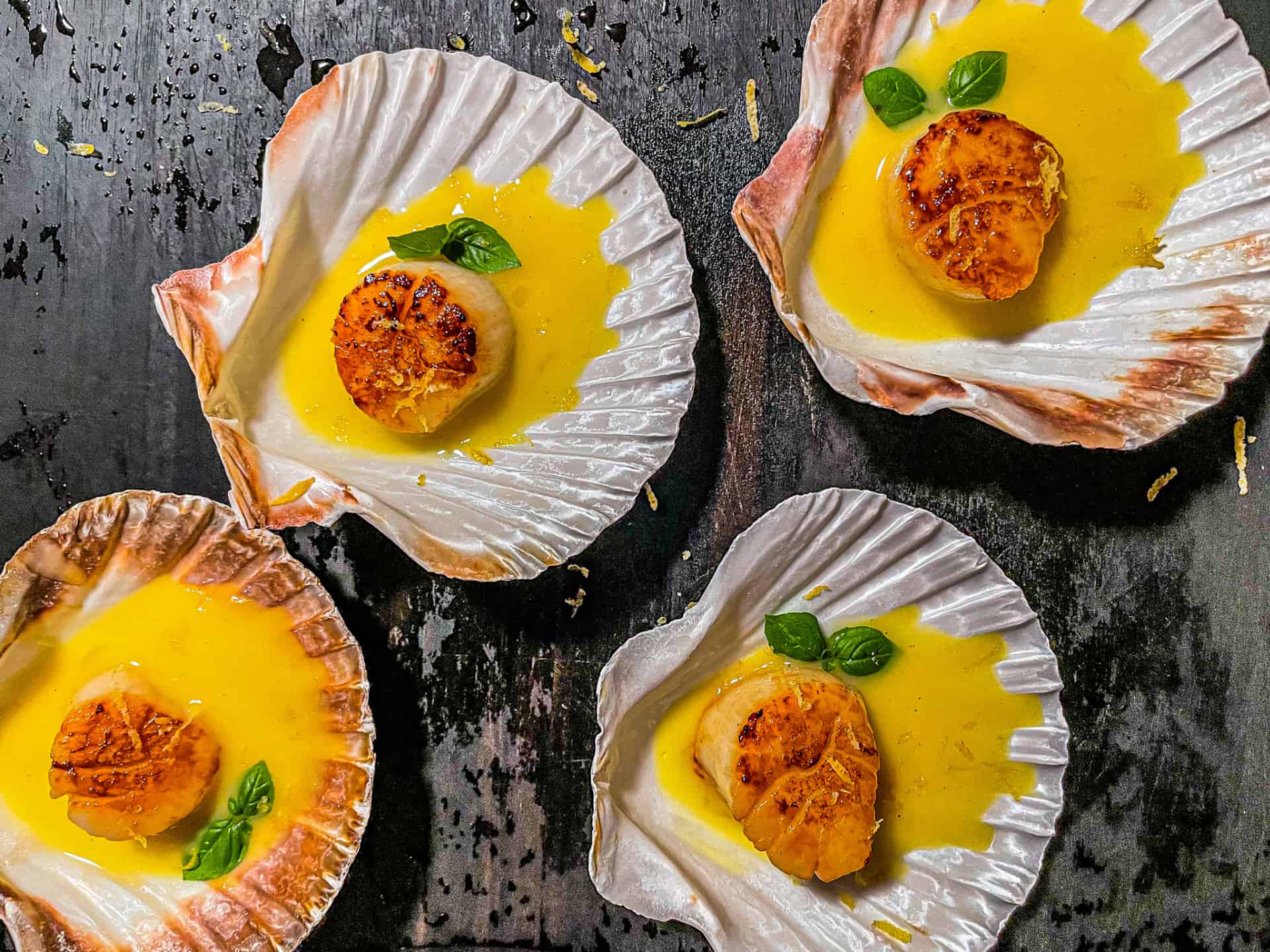
Is there any other seafood with the buttery sweetness, unique characteristics, and history of the beloved scallop? At LobsterAnywhere, we’re hard-pressed to find one. Find out how to buy fresh scallops on dry land, at sea, or online!
A (Brief) History of Scallops

In the Middle Ages, the scallop shell was a holy symbol worn on the cloaks of pilgrims traveling to the shrine of Saint James the Apostle, a fisherman from Galilee.
According to legend, Saint James’ body was lost at sea on the way to Spain for burial. Miraculously, his body was washed ashore, undamaged and covered in scallops. The scallop shells were said to signify the love of God and one’s neighbor, and the ridges were said to signify the good works that pilgrims would perform on their return. In honor of Saint James, the French named scallops Coquilles St. Jacques – “Seashells of Saint James.” Coquilles St. Jacques is also a classic dish featuring sea scallops baked in their shells with a white wine sauce and a breadcrumb-and-cheese crust.

The goddess Venus is depicted on the half shell of a scallop in Botticelli’s Birth of Venus
(1485). Credit: Google Art Project
The most famous depiction of scallops appears in the artwork portraying the birth of Aphrodite, the Greek goddess of love. (In Roman mythology, she is known as Venus.) In his famous work, The Birth of Venus, the Italian Renaissance painter Botticelli depicts Venus drifting to the shore atop the half shell of a scallop, moved by the breath of Zephyrus on the left. Spring can also be seen on the right, handing her a shawl. See it for yourself in Florence, Italy, at the Uffizi Gallery (Hall 10/14).
What is a Scallop?
What can clap without any hands, see but has no head, and swim without arms, legs or a tail? You guessed it! It is the amazing scallop.
Scallops are not a fish. They are bivalve mollusks with scallop-edged, fan-shaped shells. The shell opens and closes with the help of one large adductor muscle. It is this large muscle that is enjoyed as seafood in the USA. Harvested scallops are sold with the adductor muscle removed. Scallops are rarely sold live in the shells unless you buy them straight off the boat! The black stomach sac, intestinal vein, and coral (roe), as well as the pink segment attached to the eye, are discarded. You might find a tough membrane attached to the side; this should also be removed. In Europe, they use the whole scallop, as it is considered sacrilegious to discard the coral.
Did you know that scallops are one of the cleanest shellfish available? This is because the abductor muscle is not used to filter water, as it is with muscles, oysters, and clams. Hence, it is not susceptible to toxins or contaminants.
Unlike clams, mussels, and other bivalve mollusks, the scallop cannot close its shell completely. This is why they have a short shelf life out of water and spoil so quickly. It is critical to shuck freshly caught scallops right on the boat before they lose their moisture and die. The meat should be placed on ice immediately or frozen quickly to preserve its freshness.
What is the Difference Between Sea Scallops and Bay Scallops?
There are more than 300 species of scallops, all edible, but the two prevailing types in the Maine and chilly North Atlantic waters are sea scallops, which can grow as much as eight inches in diameter, and bay scallops, which grow to about three inches. Each ring or visible line marking on a scallop’s shell represents a year of growth.
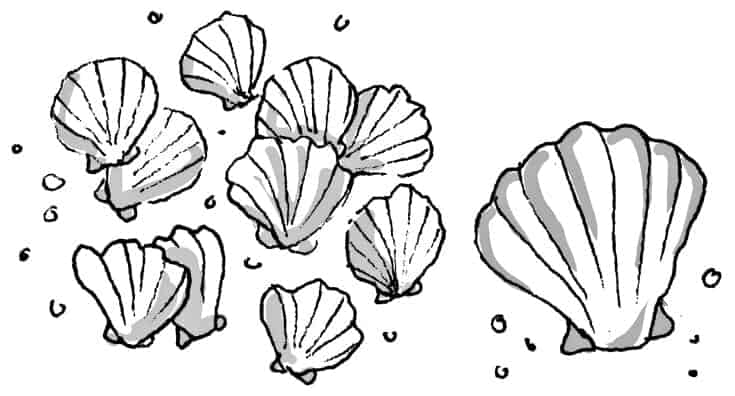
Sea Scallops
A sea scallop (Plactopecten magellanicus), which is also known as the giant scallop, deep-sea scallop, or ocean scallop, is the largest of the scallops. They live for up to 30 years and can be harvested year-round (although scallopers must pay attention to both state and regional catch limits). They are less expensive than bays and are found farther offshore in deeper waters. The larger sea scallop is versatile, as it holds up to both grilling and searing. On some restaurant menus, you might notice the term diver scallops. These are actually sea scallops that are caught by divers by hand in 70-plus feet of water.
Bay Scallops
Bay scallops (Argopecten irradiens), also known as Cape Scallops, are fished from November to March to allow for spawning (Yankee Magazine, Nov./Dec. 2015) and are found in beds of seagrass close to the shore. Unlike sea scallops, bay scallops are hermaphrodites, meaning they have both male and female reproductive organs. They have a lifespan of only 18 months and can be harvested only in their second year. Since supply is limited, they can be more expensive than sea scallops. The highly sought-after Nantucket bay scallops, for example, are so scarce they can command the highest price of any shellfish. There are cheaper imports, such as Chinese bay scallops, that were introduced to the US in the late 1980s.
Calico Scallops
Calico scallops can be found in the southern waters of the Atlantic and the Florida Gulf coast, as well as in South America. They look similar to bay scallops but are even smaller and a little darker. They are also about half the price. Be careful, as they can be marketed as bay scallops, but cannot come close to the taste and texture.
Scallop or Skawl-up?
The coastal New England states, particularly coastal Maine, Massachusetts, and Rhode Island, have their own way of enunciating the word scallop – ‘skal-lup’ –while inland folks and the remaining Northeast states pronounce it with an accent ‘skawl-up.’ Both are acceptable, but the way that a person pronounces the word will surely give away their place of origin!
Scallop Terminology
The scallop industry can be a mystery to the general public. There is a lot of misinformation.
- Wet Scallops
- Processed Scallops
- Dry Scallops
- Day Boat Scallops
- Diver Scallops
- Sea Scallops
- Bay Scallops
Processed Scallops: Wet Scallops Versus Dry
Captain’s Tip: Wet or chemically soaked scallops look unnaturally glossy and bright white and can have a soapy aftertaste (yuck). Processed scallops throw off a liquid when seared and do not brown like good dry scallops.
To be considered a scallop officially, the moisture content must be less than 80%, according to the FDA. Unfortunately, most markets carry scallops treated with sodium tripolyphosphate (STP), a chemical used to preserve, whiten, and plump them. STP is often added to fresh scallops before soaking them in water to help them absorb water and increase their size and weight. Since scallops are extremely perishable, the big markets want to extend their shelf life while saving a few ‘clams.’ These treated scallops always shrink when cooked.
What Size Scallop to Buy?
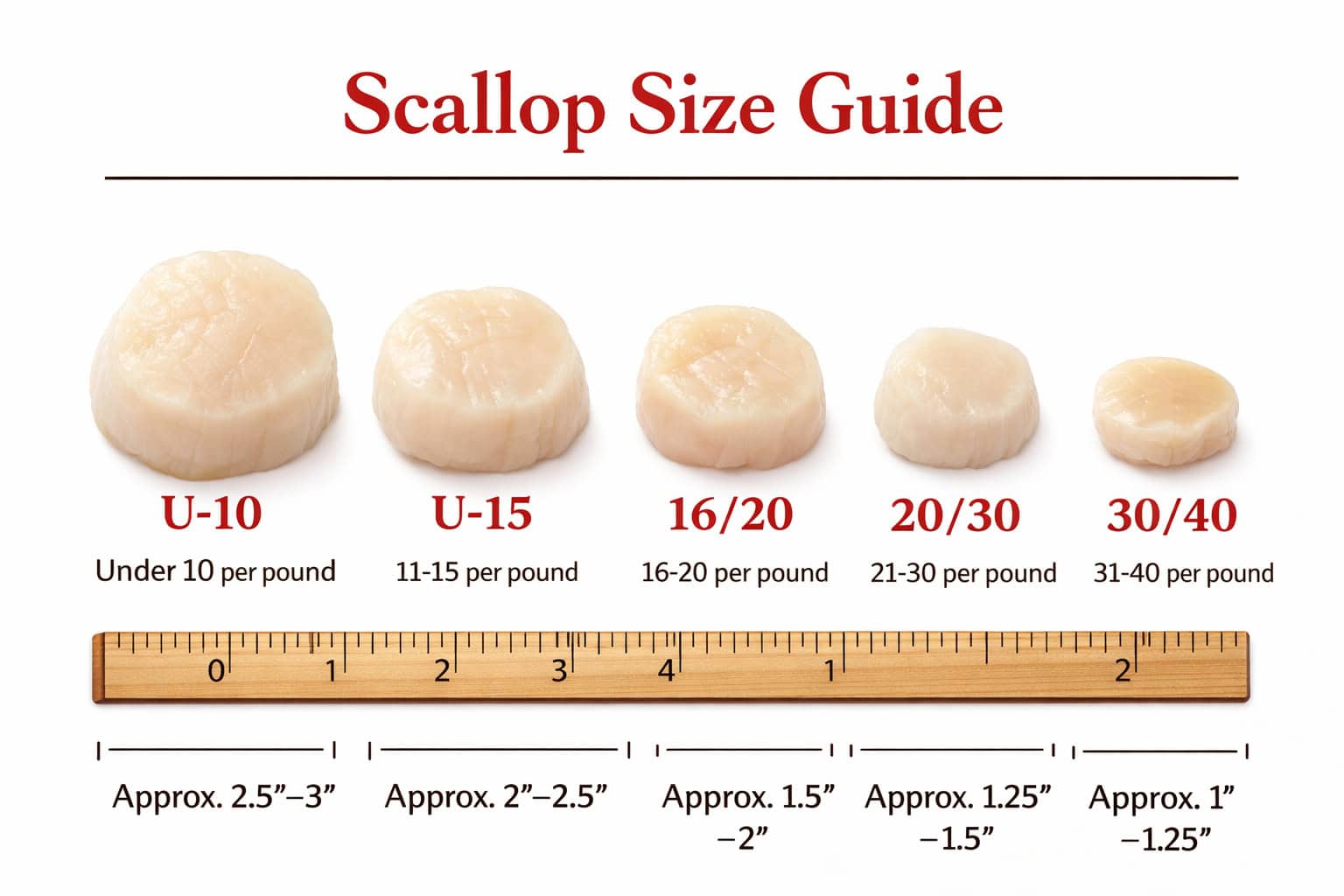
How are sea scallops sold? What is the best size? Much depends on how you plan on cooking them.
| Sea Scallop Size | How Many Per Pound | Sea Scallop Size |
| U/8 | Up to 8 Sea Scallops | Between 2 ½ – 2 ¾ inches in diameter |
| U/10 | Up to 10 Sea Scallops | About 2 ½ inches in diameter |
| U/12 | Up to 12 Sea Scallops | Between 2 ¼ – 2 ½ inches in diameter |
| 10/20 | Between 10-20 Sea Scallops | Roughly 2 inches in diameter |
| 20/30 | Between 20-30 Sea Scallops | Between 1 ½ – 1 ¾ inches in diameter |
Fishing for Scallops: From the Sea to Your Plate
Three of the top US ports hauling in sea scallops include New Bedford, MA; Cape May, NJ; and Norfolk, VA. Each seaboard state has its own regulations on catch methods and the limits on scallops. Most sea scallops are landed by large offshore trip boats. Scallopers from New Bedford, Massachusetts, will go out fishing for 10 days or more at a time. Commercial scallop fishermen use dredging nets, also called drags, which sweep the grassy beds to catch several dozen at a time. Seaweed, mussels, and starfish can be dragged up from the ocean floor. The smaller bay scallops are closer to shore and are harvested in bays and estuaries by nets, rakes, and dredges.
As sea scallops have a short shelf-life out of water, they must be removed from their shell immediately after harvesting. Shucking scallops is the toughest work in scalloping and often takes place aboard the boat at sea. The scallops are cut by hand, washed in clean salt water, placed in muslin bags, and then held on ice or flash-frozen at sea. The shell, black gut, or stomach sac, including the roe, is usually discarded.
U.S. FDA List of Scallops and Products
| Approved Name | Common Name | Scientific Name | Vernacular Name |
| Patagonian Sea Scallop | Patagonian Scallop | Zygochlamys patagonica | Chilean Scallop /Southern Scallop |
| Scallop | Scallop Saucer | Amusium japonicum | |
| Scallop | Paper Scallop | Amusium papyraceum | |
| Scallop | Thailand Moon Scallop | Amusium pleuronectes | |
| Scallop | Scallop | Argopecten aequisulcatus | |
| Scallop | Aequipecten glyptus | ||
| Scallop | New Zealand Commercial Scallop | Pecten novaezelandiae | Pure/Tipa |
| Scallop | Australian Scallop | Pecten meridionalis | Commercial Scallop / Southern Scallop/ Common Scallop |
| Scallop | Giant Scallop | Pecten maximus | |
| Scallop | Great Scallop | Pecten jacobaeus | |
| Scallop | Lined Scallop | Argopecten lineolaris | |
| Scallop | Nucleus Scallop | Argopecten nucleus | |
| Scallop | Scallop | Chlamys circularis aequisculata | |
| Scallop | Spiny Scallop | Chlamys hastata | |
| Scallop | Iceland Scallop | Chlamys islandica | |
| Scallop | Sea Scallop | Placopecten magellanicus | |
| Scallop | Peruvian Calico Scallop | Chlamys purpurata | Ostion Scallop |
| Scallop | Reddish Scallop | Chlamys rubida | |
| Scallop | San Diego Scallop | Euvola diegensis | |
| Scallop | Zigzag Scallop | Euvola ziczac | |
| Scallop | Atlantic Scallop | Mimachlamis varia | |
| Scallop | Common Japanese Scallop | Patinopecten yessoensis | Japanese Scallop |
| Scallop | Scallop | Pecten albicans | |
| Scallop or Bay Scallop | Bay Scallop | Argopecten irradians | |
| Scallop or Weathervane Scallop | Weathervane Scallop | Patinopecten caurinus | Alaskan Scallop |
| Scallop or Calico | Pacific Calico Scallop | Argopecten ventricosus | |
| Scallop or Calico | Atlantic Calico Scallop | Argopecten gibbus |
What are Diver Scallops?
Diver scallops are a premium type of sea scallop, hand-harvested by divers from the ocean floor. Known for their superior sweetness, firm texture, and large size, they are a delicacy often favored by chefs. They are always dry-packed, meaning they haven’t been treated with any chemicals. Learn more about diver scallops and how they are marketed.
Do Scallops Swim?
Half the battle when catching scallops for a seafood dinner is finding them. Bay scallops camouflage themselves in thick beds of grass that are about 4-8 feet of water close to the shoreline. They can be difficult to find, but they have three characteristics that stand out:
- They swim or jump or something: Scallops are the swiftest of the bivalves. By quickly opening and closing their shells, they use their meaty abductor muscle like a jet engine to propel themselves through the water. If you get close enough to a bed of sea grass underwater, you can watch bay scallops pop up and flitter off. This quick YouTube video by Boris CCRCam is worth watching.
- Open wide: Often referred to as filter feeders, they usually keep their mouths open to catch food particles and plankton filtering through.
- Stunning blue eyes and lots of them: Another scallop trait is its eyes, which look like a series of bright blue and turquoise gems along the edge of its shell. There are about 50 on the average scallop, but they can only detect movement and light.
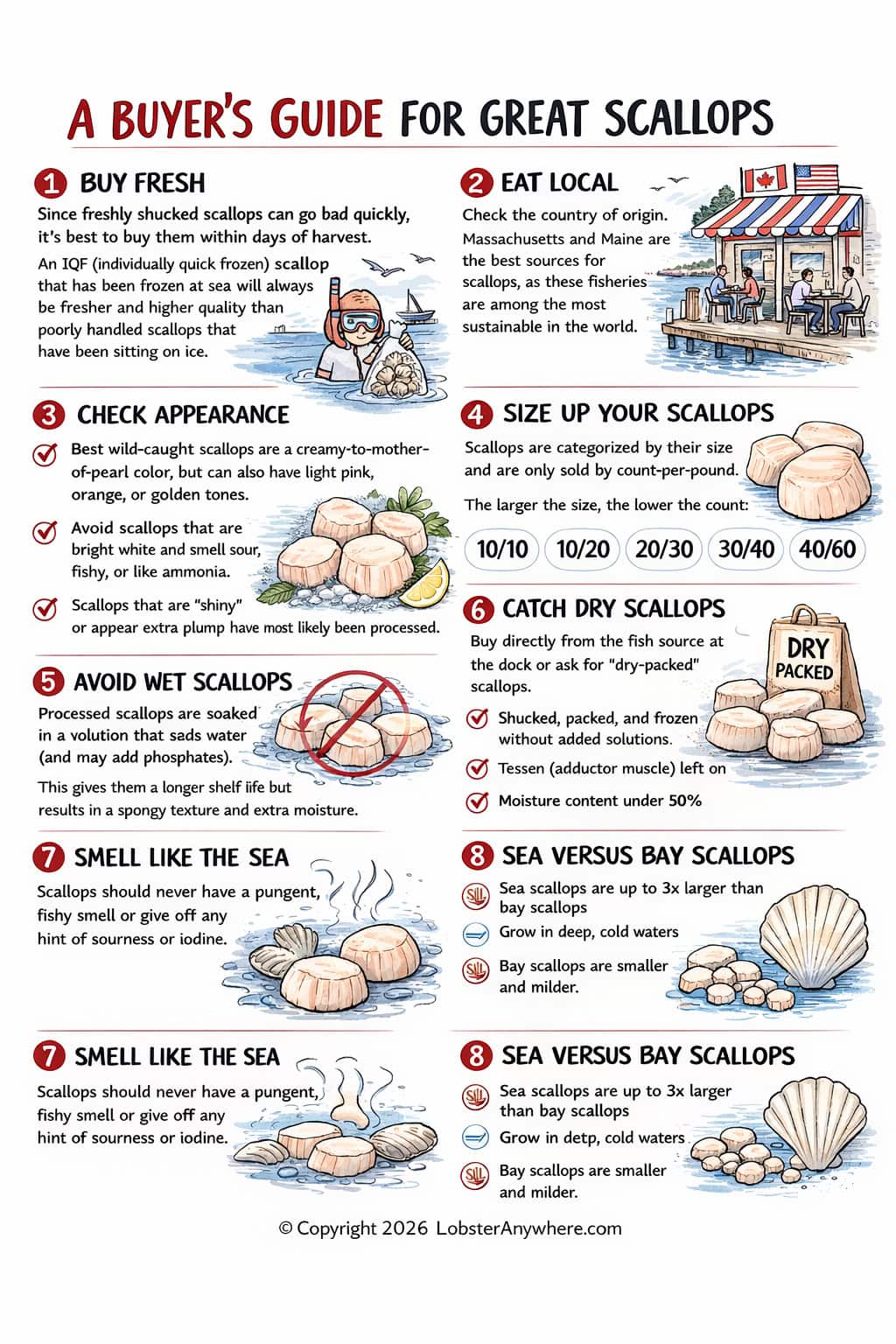
8 Seaworthy tips for buying fresh scallops
How to Buy the Best Scallops
Since the seafood supply trade is difficult to regulate, both identifying and buying quality scallops can be a tricky business. A scallop that looks a little too perfect or uniform in shape may not even be a scallop at all, but a stamped-out disk of a white fish! Even well-intentioned seafood buyers can be duped by mislabeled or even adulterated scallops. When shopping for scallops, follow this checklist:
- Buy Fresh: If possible, check the harvest date. Fresh scallops spoil quickly, so it is best to buy them within days of harvest. Individually Quick Frozen (IQF) scallops that are frozen on the boat will be far superior and much fresher than poorly handled scallops sitting on ice. Furthermore, be wary of frozen scallops that may be thawed and mislabeled as fresh.
- Buy Local: Always check the country of origin. Canada and the USA are the best sources for scallops with sustainable harvesting and seafood management laws. If the price per pound is too good to be true, it is a dead ringer for an imported, farm-raised scallop.
- Check Appearance: All-natural, dry scallops are a cream mother-of-pearl color, but they can range from grey and beige to a slight pink or orange hue. The scallop meat should be firm and translucent; it should not be split or shredded. Finally, avoid scallops with dark edges or flaky meat.
- Scallop Colors: Scallops also vary in color depending on the types of algae they consume. Scallops that are brilliant white or appear extra plump are most likely wet scallops. Scallops with an orange or pink tint are female scallops that have recently spawned. A pinkish-orange coloration means that the roe has discolored the scallop meat. This is purely cosmetic and is perfectly good to enjoy. In fact, a coral-colored scallop can have a sweeter, richer flavor than a white scallop.
- Catch Dry Scallops: Scallops should be purchased dry-packed and untreated. According to the FDA, for a scallop to be considered a scallop, the moisture content must be less than 80%. A processed scallop feels slick to the touch, while a dry scallop is somewhat sticky. If you see sodium tripolyphosphate (STP) on the label, then do not buy it.
- Avoid Wet Scallops: Processed scallops are soaked in a solution (sodium tripolyphosphate). This gives them a longer shelf life and allows them to hold more water, sometimes 20%-30% more, which artificially plumps them up. This chemical also prevents scallops from browning properly. You are not only paying for the extra weight but also for an inferior scallop. Milky scallops, or those with excess water, are a sign that they have been chemically treated.
- Size up Your Scallops: Scallops are sorted by size and sold by count per pound. The larger the size and the lower the count per pound, the more expensive they are. The “u” is the weight standard for “under” per pound. Sea scallops are available in U-10 (under 10 per pound), 10-20, 20-30, 30-40, and 40-50 per pound. Bay scallops will have higher counts since they are much smaller.
- Smell Like the Sea: Scallops should never have a pungent, fishy smell or give off any hint of sourness or iodine. Improperly chilled scallops will spoil quickly. Scallops should smell sea fresh! If there is no briny scent at all, they are very likely wet scallops.
- Sea Versus Bay Scallops: Sea scallops can be up to 3 times larger than bay scallops and are found further off the shoreline in deeper waters. They are fished all year round. Since smaller bay scallops are less abundant and subject to seasonal availability, they cost more. Depending on the state and town, bays are harvested from October to December. Beware of imported farm-raised Chinese scallops; they will always be cheaper.
Scallop Nutrition Information
Scallops are low in sodium and saturated fats and are an excellent source of protein. Did you know they have fewer calories than poultry? Scallops contain vitamins, minerals, and omega-3 fish oils.
The top five vitamins and minerals in scallops are:
- Vitamin B12
- Phosphorus
- Selenium
- Choline
- Zinc
Nutrition Facts:
- Serving size: 100g/3.5 oz. (raw).
- Calories: 87.
- Fat Calories: 7.
- Total Fat: 0.8 g.
- Saturated Fat: 0.1g.
- Cholesterol: 36 mg.
- Sodium: 87 mg.
- Protein: 16.2 g.
- Omega-3: 0.2g.
Advice on Scallop Cooking & Preparation
Some folks will pluck scallops right out of the sea and eat them on the spot. Unfortunately, not everyone is lucky enough to know a day boat scalloper. The key to maintaining flavor and freshness is to minimize the time between when they are taken from the sea and when they reach your kitchen.
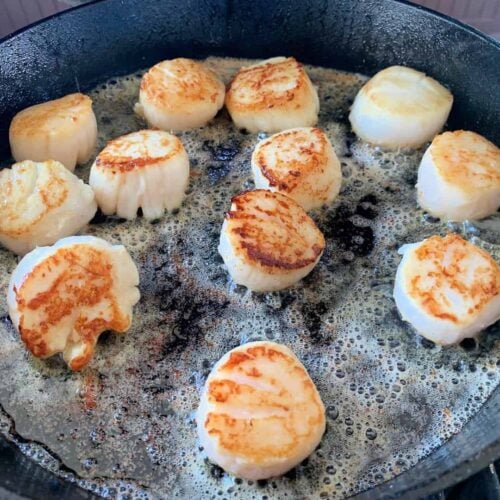
The simpler the preparation, the better. Our favorite way to cook scallops is to sear them over high heat to create a beautiful golden crust. See our step-by-step guide for searing the perfect scallop.
For more tips, see our guide for the best ways to cook scallops at home.
Go Scalloping at LobsterAnywhere
LobsterAnywhere ships all-natural, chemical-free scallops online. They are not cheap because these are REAL scallops with no solutions added. Our premium IQF dry-pack sea scallops meet or exceed USDC standards for both moisture and sizing integrity. Our beautiful sea scallops will pan-sear to perfection.

Scallops are a favorite among seafood regulars at LobsterAnywhere because you simply cannot find these jewels of the sea at your local seafood market. Our large sea scallops are about the size of a silver dollar and are designated U-10 since you receive about 10 or fewer per pound. Our scallops are harvested from scallop beds throughout the Northern Atlantic Ocean and are purchased straight from the port of New Bedford, Massachusetts, known as the scallop capital of the world.
Our succulent scallops are shipped fresh-frozen so that our customers can sear, bake, broil, or grill them to perfection. You will not find a fresher, purer scallop anywhere. Check out some of the scallop reviews from our seafood-crazy fans.
Be sure to try our recipe for baked scallops. LobsterAnywhere.com offers three scallop dishes:
- Jumbo sea scallops wrapped in bacon – Here are some tips on how to make scallops wrapped in bacon.
- Plank Scallops, also wrapped in bacon
- Sea Scallops
Don’t forget to add some fresh lobster to your order!
-
 Sea ScallopsFrom $44.00
You save

Can’t get enough scallop information? Be sure to see our list of seaworthy scallop facts!
Scallop Buying FAQ: How to Choose the Best Scallops
References
- Tammi, E., & Tammi, K. A. (2011). Scallops: a New England coastal cookbook. Gretna: Pelican Pub.
- Harris, M., Taylor, P., Best, T., & Emden, E. V. (2013). How to make love to a lobster: an eclectic guide to the buying, cooking, eating and folklore of shellfish. Vancouver, BC, Canada: Whitecap.
- SCALLOPS TRIVIA & FACTS. (n.d.). Retrieved January 16, 2017, from http://www.foodreference.com/html/fscallops.html
- How to Pronounce “Scallop” | New England Dialect. (2016, December 17). Retrieved January 16, 2017, from http://www.yankeemagazine.com/article/food/yankee-dialect-how-to-pronounce-scallop
- Brennessel, Barbara. Good tidings: the history and ecology of shellfish farming in the Northeast. Hanover, NH: U Press of New England, 2008. Print.
- Frederick, J. G., & Joyce, J. (1971).Long Island seafood cookbook. New York: Dover Publications.
- Dore, Ian. New fresh seafood buyer’s guide: a manual for distributors, restaurants and retailers. Place of publication not identified: Springer-Verlag New York, 2013. Print.
- “Pink vs. White Scallops.” Pink vs. White Scallops | Cook’s Illustrated. N.p., n.d. Web. 04 June 2017. <https://www.cooksillustrated.com/how_tos/6552-pink-vs-white-scallops>.
The best scallops I’ve ever eaten. The packaging was perfect and delivered when I needed them.