
For many people, food is dead, processed, and packaged by the time it reaches them. We know that our chicken breasts came from a chicken or that a piece of cod was once swimming around somewhere. Live lobsters are a unique food in that they must be cooked or processed quickly after they are removed from their cold seawater.
But because lobsters are traditionally cooked alive, many first-time lobster cooks wonder if there’s a more humane way to prepare them. The idea of plunging a live lobster into a boiling pot can feel uncomfortable, especially the first time. The lobster scene in Julie & Julia, where Julie Powell panics before putting live lobsters in the pot, captures exactly why this question comes up.
The Best Way to Kill a Lobster
There is no shortage of ideas about whether lobsters feel pain or not. Lobstermen refer to them as ‘bugs’ because they are much like insects, and we don’t worry about squashing them. The truth is, it may be a long time before we really understand the lobster’s nervous system.
In the meantime, if you still want to cook lobster, use a humane, proven approach to quickly dispatch it and enjoy your dinner.
Basics of Lobster Anatomy
To better understand lobster anatomy, it is worth knowing that they are in the same phylum (Arthropoda) as insects, crabs, barnacles, and shrimp. Lobsters have a hard outer shell called an exoskeleton, but don’t have an inner skeleton or bones like a mammal.
Lobsters don’t have a centralized brain as mammals do. Their nervous system is decentralized, built from nerve clusters called ganglia distributed throughout the body, with the largest cluster (the supraesophageal ganglion) located behind the eyes. Lobsters have roughly 100,000 neurons — compared to about 86 billion in a human.
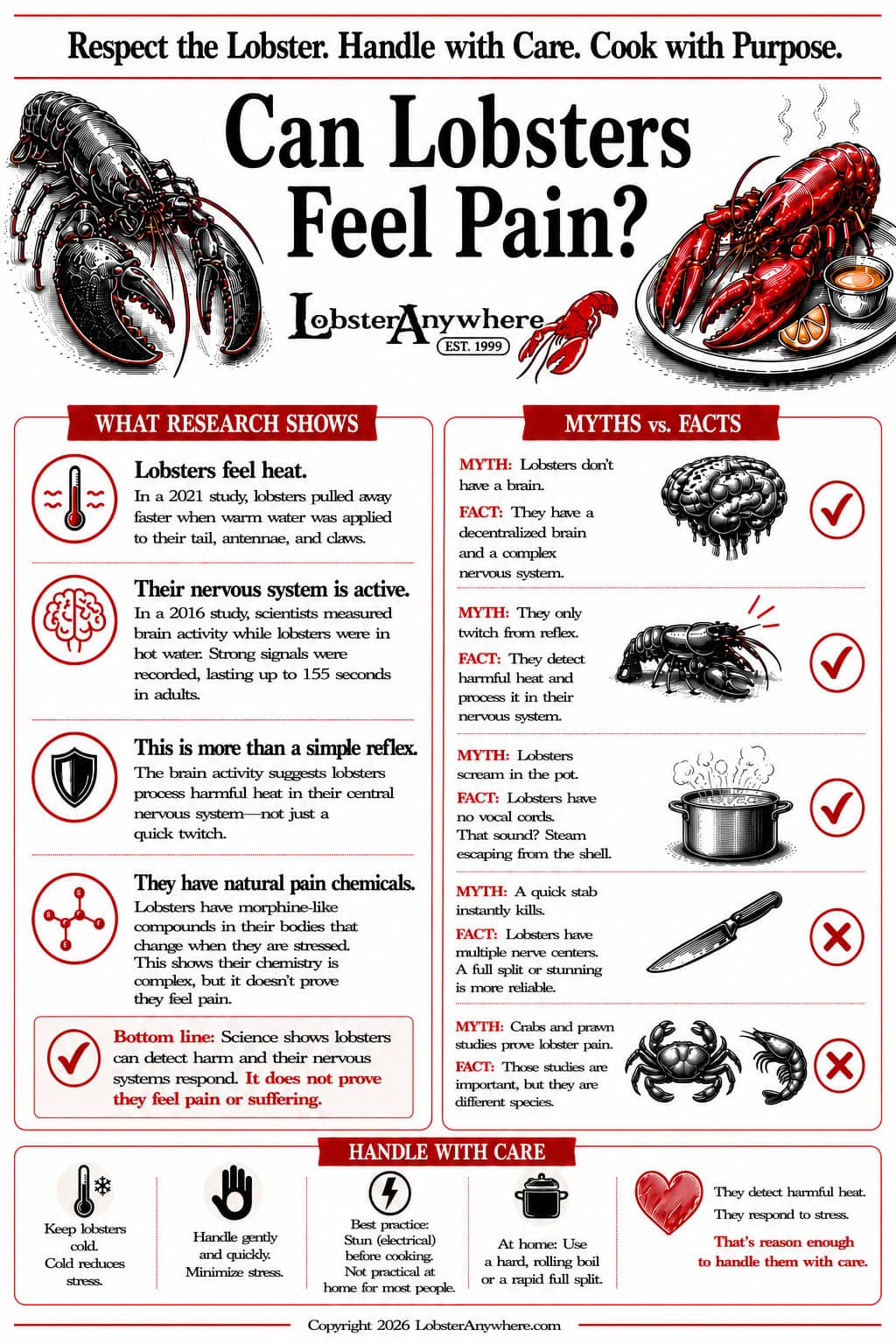
One common myth is that lobsters “scream” when cooked. They do not have vocal cords, so the sound sometimes heard during cooking is not a scream. It is more likely that steam or air is escaping from the shell and body cavity as the lobster heats. That does not settle the pain question, but it does clear up one of the most repeated misconceptions.
Neurons are the basic building blocks of the nervous system. They handle everything from detecting the environment to coordinating muscle movement. Neuron count matters, but awareness and intelligence can’t be reduced to a single number — how those neurons are organized and connected matters too.
Do Lobsters Really Feel Pain?
This is the question that comes up more than any other. Science has not settled it completely, and much of what you’ll find online either conflates species, overgeneralizes from a handful of studies, or overlooks the distinction between detecting a harmful stimulus and consciously suffering from it.
Can a Lobster Feel It — or Just React to It?
Nociception is the nervous system’s detection of something harmful and the triggering of a response, such as pulling away from heat. Pain goes further. In the animal-welfare sense, pain means an unpleasant felt experience — something the animal is consciously aware of.
An animal can have nociception without experiencing pain. The question is whether lobsters cross that line.
What the Studies on Maine Lobsters Actually Found
Here is what the direct research on Homarus americanus actually shows.
A 2021 UC San Diego study tested whether Maine lobsters respond to warm water on the tail, antennae, and claws. They did, with clear, temperature-dependent withdrawal. The authors described this as novel evidence of thermal nociception in the species.
A 2016 electrophysiology study implanted electrodes in lobster central nervous systems and recorded strong neural activity during hot-water exposure. Signals declined after roughly 47 seconds in juveniles and 155 seconds in adults. That suggests hot-water exposure is not only a local limb response; something is being processed centrally. The same study also detected electrical signals from recently dead animals during heating, suggesting that some of that activity may be a heat-related artifact rather than anything the animal experienced.
A third study found morphine-like compounds in lobster hemolymph and nerve cord, with levels changing after stress. That points to complex neurochemistry, but it is not a behavioral pain test.
Direct evidence from American lobsters confirms thermal nociception and CNS activity. It does not confirm subjective pain or suffering during cooking.
What About Studies on Other Crustaceans?
A lot of what gets presented online as proof of “lobster pain” comes from crabs, prawns, crayfish, or different lobster species — not Homarus americanus.
Shore crabs have learned to avoid shelters associated with electric shock. Prawns have shown prolonged grooming of a chemically treated antenna, with that response reduced by a local anesthetic. A 2026 study found that aspirin and lidocaine reduced escape responses in Norway lobsters (Nephrops norvegicus) following electric shock. Those findings matter for crustacean welfare broadly, but they are not direct evidence about the American lobster in your kitchen.
Where Does the Law Stand?
The law is moving in a precautionary direction, especially outside North America. The UK recognized decapod crustaceans as sentient under the Animal Welfare (Sentience) Act 2022. Switzerland requires that lobsters and similar crustaceans be stunned before being killed. New Zealand requires certain commercially killed crustaceans, including rock lobster and crayfish, to be made insensible before killing. Italy’s highest court ruled against storing live lobsters on ice, although Italy has not enacted a nationwide ban on boiling them alive.
In the United States and Canada, there is no clear federal humane-killing rule for lobsters comparable to the rules that apply to livestock.
What this does — and does not — prove:
Research shows Maine lobsters detect harmful heat and show central nervous system activity. It does not directly prove subjective pain or suffering during cooking. Stronger pain-like behavior studies often come from crabs, prawns, crayfish, or other lobster species — not Maine lobster.
How to Kill a Lobster Humanely
Whether you’re confident lobsters don’t feel pain or think the question is still open, there are ways to dispatch a lobster quickly and efficiently. In fact, there are several answers to the question of how to kill a lobster humanely.
Keep them Cold, Very Cold
Lobsters live and thrive in cold water. These sea creatures are poikilotherms, meaning they cannot regulate their body temperatures. So, they migrate to warmer, deeper offshore waters in the winter months. When lobsters are most active in the summer months, they migrate inshore and get stuck in traps searching for food. This is why summertime is often considered the peak lobster season.
| To slow a lobster down before cooking, place it in the freezer for 10–15 minutes. This makes handling safer and reduces movement, but research suggests chilling alone does not fully anesthetize the animal (Fregin & Bickmeyer, 2016). Think of it as a first step, not a complete solution. |
Head First into Boiling Water
This is one of the most commonly used solutions for dispatching a live lobster. The key to this process is to bring the water to a boil before you begin. Hold the lobster around the middle to avoid the claws and plunge it headfirst into a full, rolling boil. The water must be at a hard boil — not just simmering — and the pot needs to be large enough that the temperature doesn’t drop significantly. Research shows central nervous system activity can persist for roughly 45 seconds in smaller lobsters and over two minutes in larger adults (Fregin & Bickmeyer, 2016). Boiling water is also the best way to cook the lobster, so you can leave it in and carry on cooking. If you’re a newbie, keeping the elastic bands on the claws to protect yourself is a good idea.
See our guide for more tips on handling and storing live lobsters.

Blade Right Between the Eyes
| The other common way to dispatch a live lobster is with a very sharp knife. A rapid, full split through the head and down through the tail destroys the major nerve clusters and is widely used by professional chefs. Because lobsters have decentralized ganglia rather than a single brain, a stab to the head alone won’t shut everything down — you need to commit to the full split. |
As mentioned above, storing the lobster in the freezer will keep it dormant, making it easier and safer to handle.
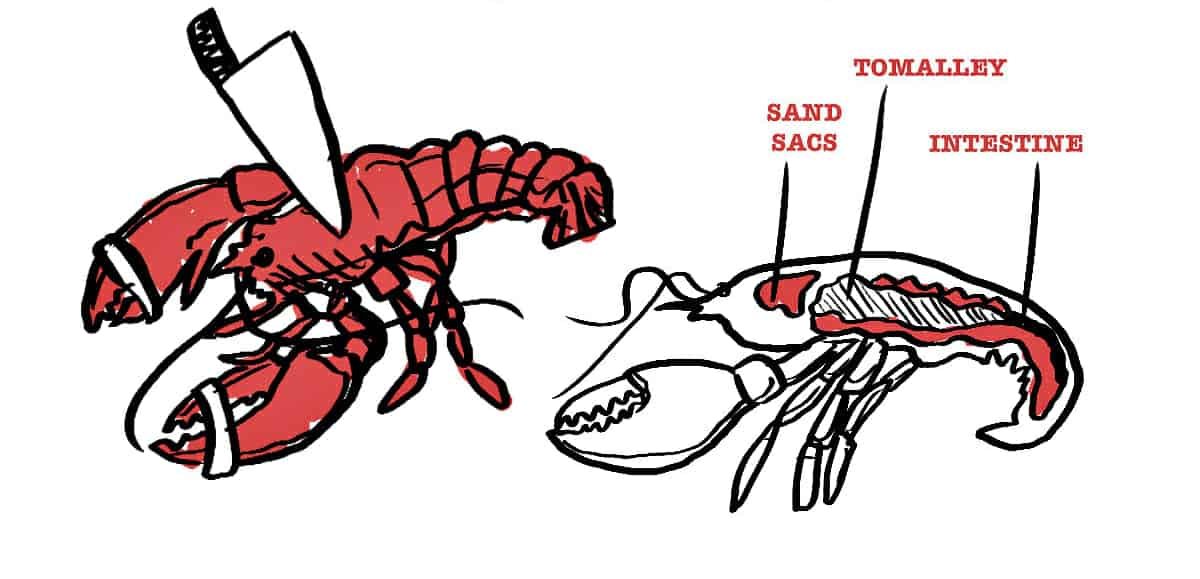
- Place the lobster on a flat surface or cutting board. Use a ribbed sheet pan to catch any liquid that spills out. Quickly plunge the tip of a sharp chef’s knife right below its eyes. You will see a cross (X).
- Cut through the head and continue cutting through the tail to split the entire lobster. Alternatively, you can simply remove the tail. Don’t worry if the legs keep moving for a little while afterward; this is an involuntary reflex.
- Remove the small sac at the base of the head and the digestive tract running along the center of the tail. Clean out the dark coral or roe, present only in female lobsters.
- Clean out the tomalley (liver and pancreas), the light green, runny material present in the lobster head, and, in some cases, on the exposed flesh of the tail.
Stun the Lobster
One of the newer ways to kill a lobster humanely is with a specially designed device called a CrustaStun. The idea is simple – it uses an electrical charge to stun and kill the lobster quickly. British lawyer Simon Buckhaven invented the crustacean zapper in 2006.
| At around $3,000, the CrustaStun is designed for commercial kitchens rather than home cooks. A jolt of electricity is favored by some animal-rights groups, who see it as a better option than boiling or using a knife. |
How to Put a Lobster To Sleep and Other Unusual Approaches
As with every dilemma, there are people who find somewhat novel approaches to the topic. One example is the idea of hypnotizing the lobster. That’s right – you stand the live lobster on its head and rub between the eyes up and down constantly.
This puts it in a ‘hypnotic state’ that will leave it standing on its head without you holding it. You can then take a knife and split it down the middle without it ever waking up. Or so we have been told.
Can Cannabis Make Lobster Cooking More Humane?
The latest approach to the question of humanely killing a lobster is a theory that marijuana somehow lessens the lobster’s pain. A Maine restaurateur thinks so. She used pot smoke in an attempt to ‘medicate’ the lobster before it hit the hot water bath. The idea was that cannabis exposure might reduce the lobster’s response before cooking.
| Can lobsters get high? A UC San Diego research team (Gutierrez et al., 2021) actually tested this. They exposed Maine lobsters to THC vapor using an e-cigarette device and measured tissue levels and behavioral effects. THC did show up in all tissues tested, and it slowed locomotion, but its effect on thermal nociception was minimal. In other words, the lobsters moved less but still reacted to heat about the same. The Maine state health department, meanwhile, shut down the original restaurant’s idea of selling cannabis-exposed lobsters on food safety grounds. |
How to Kill a Lobster: The Short Version
Science does not give us a clean yes-or-no answer on whether Maine lobsters feel pain the way humans do. What it does show is that Homarus americanus can detect harmful heat and respond to it, and that its central nervous system can remain electrically active during hot-water exposure longer than many people assume. In one electrophysiological study, hot-water exposure elicited strong CNS signals that declined after roughly 47 seconds in juvenile lobsters and 155 seconds in adult lobsters, although the authors also noted that some heat-related signals may arise from recently dead tissue during cooking. That is reason enough to handle live lobsters carefully and dispatch them as quickly and carefully as practical.
For home cooks, brief chilling can make the lobster easier and safer to handle, but it should not be described as a proven form of anesthesia or a humane killing method on its own. Once ready, use a hard, rolling boil or a rapid full split through the midline with a large, sharp knife. For the highest welfare standard, animal-welfare guidance increasingly favors electrical stunning before cooking, though that is not practical for most home kitchens.
We’ve been shipping live lobsters since 1999. We take live handling seriously, and we think home cooks should too: keep lobsters cold, minimize stress, and cook or dispatch them promptly.
Lobster Killing & Cooking Questions
The most debated methods involve prolonged exposure to stressors without a quick kill — for example, slow heating from room temperature or extended time on ice without dispatch. The goal of any method should be speed: reduce the time from a living animal to a dead one. Whether that’s a hard boil, a full knife split, or electrical stunning, the key is committing to it quickly and decisively.
Splitting a lobster before boiling is standard practice for grilling, broiling, or baking. For boiling or steaming, most home cooks go straight into the pot headfirst. Both approaches work. If you’re splitting first, use a sharp knife and commit to a full cut from head through tail — a partial stab to the head alone won’t fully dispatch the animal because the nervous system is decentralized.
Sources & Further Reading
The following sources informed the science and legal context discussed in this article.
- Fregin, T. & Bickmeyer, U. “Electrophysiological Investigation of Different Methods of Anesthesia in Lobster and Crayfish.” PLOS ONE, 2016. Measured neural activity in lobster and crayfish nervous systems during chilling, boiling, and electrical stunning.
- Gutierrez, A. et al. “Vapor Exposure to Δ9-Tetrahydrocannabinol (THC) Slows Locomotion of the Maine Lobster.” Pharmacology Biochemistry and Behavior, 2021. UC San Diego study testing whether THC vapor affects Maine lobster behavior and heat response.
- Birch, J. et al. “Review of the Evidence of Sentience in Cephalopod Molluscs and Decapod Crustaceans.” London School of Economics, 2021. Reviewed evidence on crustacean sentience and helped inform the UK’s Animal Welfare (Sentience) Act 2022.
- Crump, A. et al. “Sentience in Decapod Crustaceans: A General Framework and Review of the Evidence.” Animal Sentience, 2022. Peer-reviewed framework for evaluating pain and sentience evidence across decapod species.
- Animal Welfare (Sentience) Act 2022. United Kingdom Parliament. Recognizes decapod crustaceans and cephalopod molluscs as sentient beings under UK law.
- University of Maine Lobster Institute. Anatomy, biology, and educational resources on Homarus americanus.
- New Zealand Animal Welfare Regulations. Requires certain commercially killed crustaceans, including rock lobster and crayfish, to be made insensible before killing.
I also heard that if you started the Lobsters in pots of tepid water and turned on the heat, the Lobsters would pass out and be unconscious when the water reached boiling.Has anyone else heard that? I’m a coward and only eat Lobster in restaurants so it arrives ready to eat on a plate at my table.
This whole thing has traumatized me to the point where I will never eat lobster 🦞 again!
Anyone who has driven a knife into a lobster or the underside of a crab knows that it absolutely does cause pain to that creature. It’s absolutely obvious that it is dying in agony, the same as when you put it into boiling water.
Yeah, these people are delusional. Their humane method is boiling them alive. What unethical codswallop
We cook the lobsters in tomato sauce every Christmas Eve so I have to take the body apart before putting it in the pot of sauce. I used to start by cutting the head off but I’m going to do the sharp knife behind the eyes. I’m an animal lover so it does bother me to kill them but I feel much better knowing they may not feel any pain and if so at least it’s quick. If it bothers you to kill a lobster you should look up how cows, pigs, chickens and horses are killed.
That’s exactly right Adrienne. People are very concerned about lobster pain because they have to kill it themselves but give zero thought to how your steak got on the table. Let’s not forget we are at the top of the food chain. Given an instance where we were starved and forging for food, our needs would be met. Eat lobster and enjoy, and cut it to feel a little more kind.
There is overwhelming evidence to support that lobsters feel pain! They are actually reasonably intelligent creatures. Most people wouldn’t enjoy being boiled alive, how about a little more awareness for other living things?
There is some evidence to support the claim that lobsters feel pain, and there is also some evidence to dispute this. In the final analysis we are preparing food to eat and try to be compassionate about how to prepare it.
Yesterday I cooked a pair of lobsters, and made the mistake of putting them both on the cutting board together. They had been in the fridge for several hours, and were very docile until I killed the first lobster, at which point the second lobster panicked and tried very hard to escape. I am certain that the second lobster was aware of what happened to the first one, and I feel terrible, because I think the second lobster knew what was about to happen to it.
All living things ‘feel pain’ as a sense that causes a reaction. In higher forms of sensitivity the reaction can be profound and even traumatic as intelligence creates it’s own sensation such as fear of dying. To ‘feel’ bad for the lobster you’re about to eat is a sort of transfer of pain. To yourself. As a simple-minded New Englander, I toss the bastids in head first and then heat the butter.
This isn’t accurate. There was a study done with hermit crabs and pain, using electric shock. The results suggested the ability to feel pain as the crabs sought shelter from the shocks and even attacked the empty shells after leaving them.
Whether lobsters feel pain is still up to debate. They may or may not feel pain, but in the end they are consumed as food and we also aim to minimize pain. As far as the study you mentioned, lobsters are not crabs. Hermit crabs are anomuran decapod crustaceans of the superfamily Paguroidea. Maine lobster, homarus Americanus is clawed lobsters of the family Nephropidae. See our article all about lobsters.
If you want to get a more balanced view on the topic of lobster and pain, read this really interesting Wikipedia article: https://en.wikipedia.org/wiki/Pain_in_crustaceans
Yes, thanks for the Wikipedia article link of whether lobster’s experience pain. There are plenty of articles and points on both sides. At the onset of the article it states it is a matter of scientific debate. What’s important is how you can minimize any potential for pain. We are biased as we are a lobster company, and shellfish is food and a livelihood of many New England families.
I rub the head shell for about 1 minute and the lobster gets hypnotized and spreads wide the claws. Then I plunge into boiling water. It seems to be the humane way as I was told by a French chef. At least I feel better about it.
But it’s also Wikipedia so, not a reliable source considering anyone can alter the articles on it.
Terrie, please tell me more stories about you and your husband’s adventures. This is hysterical!
I remember back in 1977, my husband and I purchased a live lobster. We chose the boiling water method to dispatch the lobster. We put it into the boiling water, immediately attempting to put the lid on. The lobster was upside down, and with a flip of it’s tail, knocked the lid off. My husband screamed like a woman. We were so traumatized, we couldn’t eat the lobster. I’ve never eaten lobster since then.
This reminds me of Mike Rowe talking about a “Dirty Jobs” episode on a Montana sheep ranch. It was lambing season, and lambs were having their tails docked (yes, another controversial subject). When the first lamb was picked up, the farmer whipped out his dicking knife, sliced the tail off, dabbed some tar on the stub, and sent it back to its mother. The crew gasped! You can’t do that… That’s cruel and painful… The farmer said– “Oh, you want the PETA approved method. Get the elastrator” he said to his wife. The next lamb got a tight elastic band applied to the base of its tail, and when put back down, commenced jumping around, obviously not liking the feeling of that band slowly constricting the nerves and blood vessels. It takes anywhere from five to ten minutes for the lambs tail to go numb. Mike Rowe and the crew learned something that day.
As for jabbing a knife into the head nerve ganglia of a lobster– as my college invertebrate biology professor noted about that famous Julia Child episode– the thoracic and abdominal ganglia are still intact and operating.
Just keep the lobster cold until you’re ready to plop it in the pot.
This is a little confusing. The lesson about how to dispatch the lobster with a knife then has you taking the entire lobster apart right away, while it’s still raw. But if you’re getting ready to cook it, why not just plunge the knife through the head to kill, then put the whole thing in the boiling pot to cook? That’s what I did — no food poisoning. I followed the rest of the steps to take it apart *after* I cooked it.
That’s a good question about dispatching lobsters before cooking. The steps can sure be changed,but boiling and steaming are not the only methods of cooking lobster. Poaching or grilling or even baked stuffed lobster will call for different steps. It’s also important to note that the claw and tails can cook at different times due to the thickness of the shell.
A knife exclusively in the head will do nothing but inflict more pain. Remember lobsters do not have a brain in the head and so this method would not dispatch the animal quickly.
This is up to some debate. Lobsters do have a decentralized nervous system, but the largest “main” ganglion is in the head behind the eyes. The thrust of the knife will immobilize the largest ganglia in the lobster and make it easier to handle. Do lobsters feel pain is a “hot” topic. Lobster do respond to stimulus and its environment, but it doubtful they experience human feeling or thought. Whether lobsters’ nervous systems are complex enough that they can feel pain is inconclusive. Lobster’s nervous system is closely related to insects, not mammals. We think boiling and steaming are the quickest way to shut down the ganglia all at once in less than a minute or two. In the final analysis we are killing the crustacean to eat it; and in doing so we always want to do it as humanely as possible.
Crayfish, which are closely related to lobsters, are very temperature sensitive. This has been shown in a thermal gradient, where they will compete for their preferred temperature.
it may also be that lobsters never developed pain nerves for heat because they evolved where they would never encounter boiling water or fire
Maybe 🤷♀️ now I feel better lol. A lot better once I’m munching on my tasty lobster!